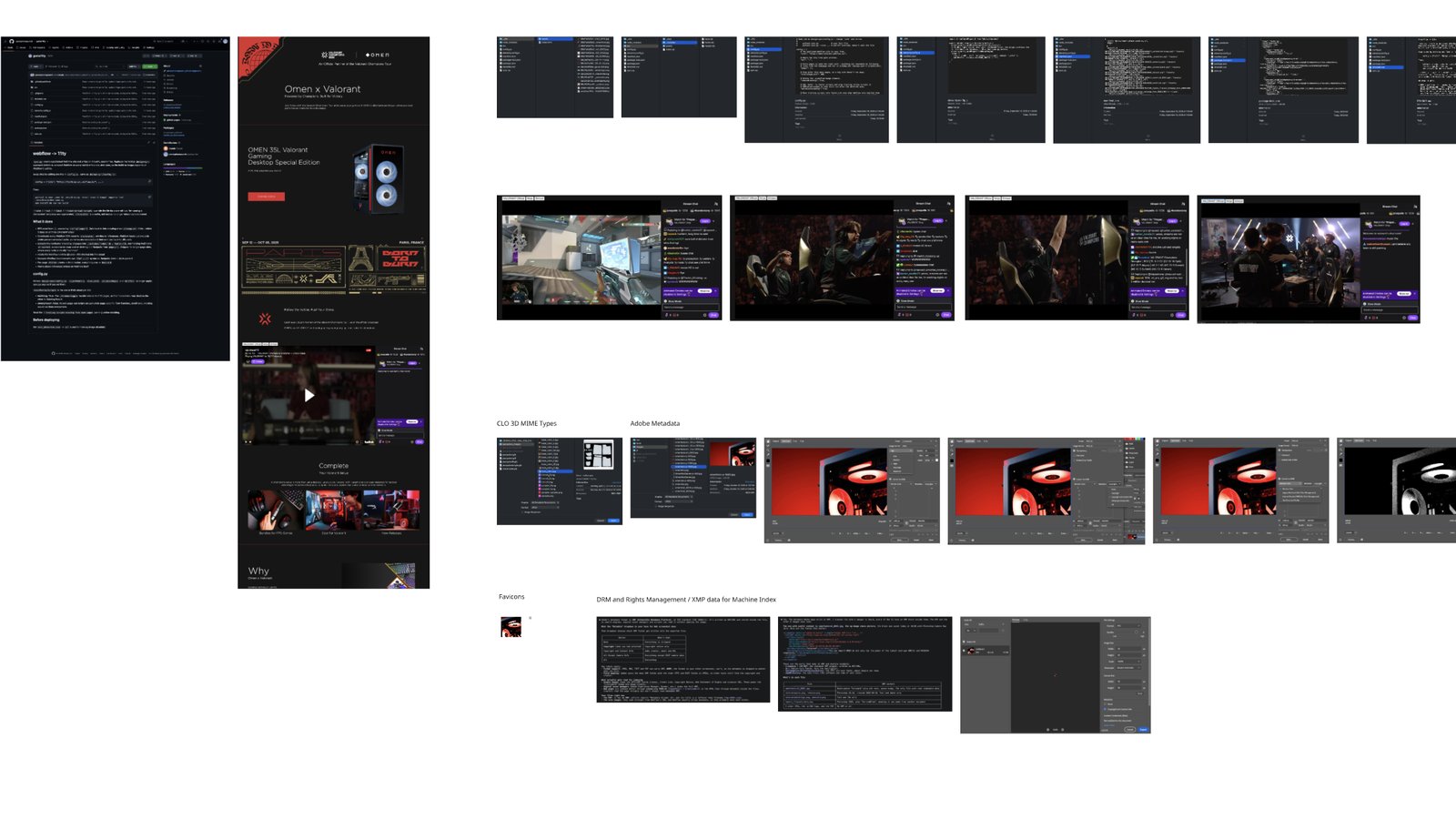
Search engines, asset managers and AI models decide what an image shows, and who controls it, from text: the alt attribute, the metadata inside the file, and structured data on the page. When those three agree, a machine doesn't have to guess. When they're missing or contradict each other, it guesses, and the guess travels with the image into indexes, datasets and model outputs.
This article explains each layer, the Adobe XMP standard behind embedded metadata, how it's stored in JPG, PNG and WebP, and how rights fields act as a lightweight form of DRM. It ends with a worked example, the game11ty site, and a checklist for agencies and media teams.
Companion article: Asset Management, Security and AI on the CRM Sync knowledge base — the media manager's view of the same pipeline: what a re-encode destroys and what it protects, raster and mesh compression including Draco and KTX2, and where media should live.
Challenge: browser tests and EDI used to be enough. A browser test showed the page worked, and an EDI batch moved the order to SAP within 15 minutes. Now AI agents read, decide and act on the same data in seconds, retry on their own and repeat themselves. Testing and evaluation have to change too: test the data as well as the code, prove where regulated values go, and escalate high-stakes changes to a human. See Testing the pipeline.
1. Three layers, one description
An image on the web can be described in three places. Each is read by different machines, and only one of them travels with the file.
| Layer | Where it lives | Who reads it | Survives a download? |
|---|---|---|---|
HTML alt |
The <img> tag on the page |
Screen readers, search crawlers, AI models that read the page | No: it stays on the page |
| Embedded XMP | Inside the image file's bytes | DAMs, Google Images, scrapers, AI training pipelines | Yes, unless a tool strips it |
| schema.org JSON-LD | A <script type="application/ld+json"> block on the page |
Search engines, knowledge graphs | No: it stays on the page |
The page layers describe the image in context: what it's doing on this page. XMP describes the image as an object: what it shows and who owns it, wherever it ends up. Write the same description into all three. A crawler that reads the page and a pipeline that only ever sees the file then reach the same answer.
2. The Adobe XMP standard
XMP (Extensible Metadata Platform) is Adobe's metadata format, standardised as ISO 16684-1. An XMP block is an RDF/XML document wrapped in an <x:xmpmeta> element and stored inside the file as a packet. Every Adobe app reads and writes it, and so do exiftool, DAMs and most image libraries.
Each field belongs to a namespace, and the prefix says who defined it. These are the ones that matter for description and rights, with the names the IPTC Photo Metadata Standard 2025.1 gives them:
| Field (IPTC name) | XMP property | What it holds |
|---|---|---|
| Alt Text (Accessibility) | Iptc4xmpCore:AltTextAccessibility |
Short description, the same as the HTML alt |
| Extended Description (Accessibility) | Iptc4xmpCore:ExtDescrAccessibility |
Longer description for complex images |
| Description | dc:description |
General caption |
| Creator | dc:creator |
Person or organisation that made it |
| Copyright Notice | dc:rights |
The copyright line |
| Credit Line | photoshop:Credit |
How to credit it when published |
| Web Statement of Rights | xmpRights:WebStatement |
URL of the rights or licence page |
| Licensor URL | plus:Licensor → LicensorURL |
Where to license it |
| Data Mining | plus:DataMining |
Whether data mining and AI/ML training are allowed |
| Digital Source Type | Iptc4xmpExt:DigitalSourceType |
How it was made: camera, composite, AI-generated |
| Edit history | xmpMM:History |
Which software saved it, and when |
The packet looks like this. It's from the game11ty share image, trimmed:
<x:xmpmeta xmlns:x="adobe:ns:meta/">
 <rdf:RDF xmlns:rdf="http://www.w3.org/1999/02/22-rdf-syntax-ns#">
  <rdf:Description rdf:about=""
    xmlns:dc="http://purl.org/dc/elements/1.1/"
    xmlns:Iptc4xmpCore="http://iptc.org/std/Iptc4xmpCore/1.0/xmlns/"
    xmlns:xmpRights="http://ns.adobe.com/xap/1.0/rights/">
   <dc:description><rdf:Alt><rdf:li xml:lang="x-default">Inside the OMEN 35L Valorant special edition desktop…</rdf:li></rdf:Alt></dc:description>
   <Iptc4xmpCore:AltTextAccessibility><rdf:Alt><rdf:li xml:lang="x-default">Inside the OMEN 35L…</rdf:li></rdf:Alt></Iptc4xmpCore:AltTextAccessibility>
   <xmpRights:Marked>True</xmpRights:Marked>
   <xmpRights:WebStatement>https://persephonepunch.github.io/game11ty/rights/</xmpRights:WebStatement>
  </rdf:Description>
 </rdf:RDF>
</x:xmpmeta>
Text fields are rdf:Alt lists keyed by xml:lang, so one file can carry alt text in several languages. Because the packet is RDF, a parser gets subject–property–value triples, not loose strings.
3. Where XMP lives in JPG, PNG and WebP
The XMP packet is the same in every format. Only its container changes: each format has its own slot for it, next to (not inside) the pixel data.
| Format | Slot for XMP | How to recognise it | Also carries |
|---|---|---|---|
| JPG | APP1 segment (marker FF E1) before the image data |
Starts with http://ns.adobe.com/xap/1.0/ + a null byte |
EXIF in another APP1, legacy IPTC in APP13, colour profile in APP2 |
| PNG | iTXt text chunk |
Keyword XML:com.adobe.xmp |
EXIF in an eXIf chunk |
| WebP | XMP chunk (the fourth character is a space) in the RIFF container |
The VP8X header's XMP flag must be set (spec) |
EXIF in an EXIF chunk |
I read these slots directly from the game11ty files: every JPG has its XMP in APP1 and every PNG in iTXt:XML:com.adobe.xmp. The share image also has a legacy IPTC APP13 block, which exiftool keeps in sync with the XMP so older tools see the same copyright.
Because the metadata sits beside the pixels, any tool that re-encodes an image can drop it without changing how the image looks. The usual culprits are image CDNs and optimisers that convert to WebP or AVIF, social platforms, and "export for web" presets set to None. A rule of thumb: whenever an image passes through a tool, check that the rights fields came out the other side.
4. How Python reads it: scraping as a semantic breakdown
Scraping a page isn't copying it. A scraper breaks the rendered page into roles: this is a heading, this is an image, this is its description, this block is structured data. The pixels arrive as opaque bytes, and the only thing they can say about themselves is their XMP. So a scraper ends up with two sources of meaning for every image: what the page says about it, and what the file says about itself.
The script below reads all three layers for every image on the live game11ty page, using requests, BeautifulSoup and the standard XML parser:
import json, re, requests
import xml.etree.ElementTree as ET
from urllib.parse import urljoin
from bs4 import BeautifulSoup

PAGE = "https://persephonepunch.github.io/game11ty/"
NS = {"rdf": "http://www.w3.org/1999/02/22-rdf-syntax-ns#",
      "dc": "http://purl.org/dc/elements/1.1/",
      "Iptc4xmpCore": "http://iptc.org/std/Iptc4xmpCore/1.0/xmlns/",
      "xmpRights": "http://ns.adobe.com/xap/1.0/rights/"}

def xmp(data: bytes) -> dict:
    """Find the XMP packet in JPG/PNG/WebP bytes and read it as RDF."""
    m = re.search(rb"<x:xmpmeta.*?</x:xmpmeta>", data, re.S)
    if not m:
        return {}
    descs = ET.fromstring(m.group()).findall(".//rdf:Description", NS)
    def text(prop):                     # a property can sit in any Description,
        pre, name = prop.split(":")     # as an element or as an attribute
        for d in descs:
            el = d.find(prop, NS)
            if el is not None:
                li = el.find(".//rdf:li", NS)
                return (li if li is not None else el).text
            if d.get(f"{{{NS[pre]}}}{name}"):
                return d.get(f"{{{NS[pre]}}}{name}")
    return {"alt": text("Iptc4xmpCore:AltTextAccessibility"),
            "rights": text("dc:rights"),
            "webStatement": text("xmpRights:WebStatement")}

soup = BeautifulSoup(requests.get(PAGE).text, "html.parser")
ld = {o["contentUrl"]: o for s in soup.find_all("script", type="application/ld+json")
      for o in json.loads(s.string).get("@graph", [])}

for img in soup.find_all("img"):
    url = urljoin(PAGE, img["src"])
    page_alt = img.get("alt")                   # layer 1: the page
    file_meta = xmp(requests.get(url).content)  # layer 2: the pixels' own XMP
    graph = ld.get(url, {})                     # layer 3: JSON-LD
Run against the live site on 3 October 2026, it found all three layers on every one of the 8 raster images, with matching descriptions and a rights URL in each file.
Two things in this code generalise to any metadata parser:
- Treat XMP as RDF, not text. The same property can be written as an element or an attribute, and exiftool spreads properties across several
rdf:Descriptionblocks, one per namespace. My first version read only the first block and reported every rights field as missing. - The page and the file are read separately.
img.get("alt")comes from the DOM;xmp()comes from bytes fetched on their own. A dataset built from downloaded images only ever sees the second.
Crawling: BFS, DFS and the files that set the rules
Before a scraper can break a page into roles, it has to find the pages. game11ty's sync.py does this with a BFS crawl, short for breadth-first search: it visits a site level by level, starting from the home page.
- Put
/in a queue. - Take the page at the front of the queue and download it.
- Collect its internal links, and add any page not seen before to the back of the queue.
- Repeat until the queue is empty or the page limit is reached (200 in
config.py).
Level 0:  /
Level 1:  /about   /products   /contact          ← linked from the home page
Level 2:  /products/omen-35l   /products/headset ← linked from level 1
The alternative is DFS, depth-first search: follow one link, then the first link on that page, as deep as possible before backing up. On a site with a blog or long pagination, DFS can spend its whole budget in one corner. BFS reaches the main pages first, finds each page by its shortest route, and can't be trapped by one long chain of links. The "seen" list stops pages that link to each other from being fetched twice.
A crawl copies what's reachable by links, not the site's file tree; a web server never shows its files. Pages nothing links to are missed unless they're listed in sitemap.xml or seeded in config.py, uploads no page uses are never copied, and CMS data, drafts and password-protected pages stay behind.
The files that tell crawlers the rules. Four conventions let a site describe how crawlers and AI should treat it:
| File or tag | Where it lives | What it says | Does it enforce anything? |
|---|---|---|---|
robots.txt |
/robots.txt at the domain root (RFC 9309) |
Which paths each crawler may fetch, by name, including AI crawlers | No. Well-behaved crawlers obey it; hostile ones ignore it, and listing a private path advertises it |
nofollow |
rel="nofollow" on a link, or <meta name="robots" content="nofollow"> for a whole page |
Don't follow this link. Google also reads sponsored and ugc |
No. Google treats it as a hint, and the page can still be found through sitemaps or other links (Google) |
security.txt |
/.well-known/security.txt (RFC 9116, 2022) |
Where to report a vulnerability. Contact and Expires are required |
No. It's a contact card for security researchers |
llms.txt |
/llms.txt, or under a subpath |
A Markdown summary of the site with links to versions written for AI, such as Markdown pages. A 2024 proposal by Jeremy Howard, not a standard (llmstxt.org) | No. It's an invitation, not a permission |
The security point: all four are declarations, not locks. They steer the crawlers that choose to listen, so use them for that: robots.txt and nofollow to keep good crawlers on the right pages, security.txt so people can report problems, llms.txt to point AI at clean, rights-labelled content. Never put secrets or private paths in them, since they're public. What actually keeps a crawler out is the allow list, sign-in and encryption described in later sections.
game11ty deliberately has none of these files: it's a demo, not meant to be found or ranked. They're here because a developer making content for AI security needs the concepts. Know which signals crawlers read, that robots.txt and security.txt must sit at the domain root while llms.txt can live under a subpath, and that none of them replaces real access control. game11ty's own sync.py doesn't read robots.txt, which is fine for crawling your own site; a crawler of other people's sites must respect it.
5. Optimization and bit size
Across the 15 images on game11ty, metadata adds 56 KB to 4.1 MB, or 1.4%. That cost is fixed per file, not per pixel, so it barely registers on large photos and dominates small icons. These are the measured figures:
| File | Size | Metadata | Share |
|---|---|---|---|
| HyperX hero PNG, 2880 px wide | 2,031 KB | 3.4 KB | 0.2% |
| OMEN desktop PNG | 633 KB | 3.5 KB | 0.6% |
| Gear photo JPG | 160 KB | 5.2 KB | 3.2% |
| Share image JPG | 99 KB | 7.1 KB | 7.1% |
| 32 px favicon PNG | 5.3 KB | 2.5 KB | 47% |
| Red emblem PNG | 6.1 KB | 3.8 KB | 63% |
Three things shape that cost:
- Padding. Adobe tools and exiftool leave empty space inside a JPEG's XMP packet so it can be edited later without rewriting the file. In the share image that padding is 2,498 bytes, about 40% of its packet. The PNG packets carry only 74 bytes.
- Edit history.
xmpMM:Historyand document IDs record every save. They are useful in a DAM and dead weight on the web. - What you actually need. Stripping the 32 px favicon to bare pixels gives 2,821 bytes; adding back only alt text, copyright and the rights URL gives 3,818. A minimal rights set costs about 1 KB.
Frame load. In both JPG and PNG the metadata sits before the pixel data: the APP segments come before the JPEG scan, and the iTXt chunk came before IDAT in every PNG checked. A browser decodes nothing until those bytes have arrived, so on a slow connection every kilobyte of metadata delays the first painted row. All four JPGs here are baseline, which decode top to bottom as bytes arrive; a progressive JPEG paints a coarse full frame first. Either way, a lean packet means the first pixels arrive sooner.
Bit depth. Every PNG here is 8 bits per channel. A 16-bit PNG doubles the pixel data and adds nothing a screen can show, so check for it before worrying about metadata.
Conversion strips by default. Converting the 101 KB gear photo to WebP with Google's cwebp gave 28 KB and no metadata at all: the alt text and rights were gone. With -metadata xmp the result was 33 KB and both survived. Other encoders and optimisers, including Rust-based tools such as oxipng, also drop metadata unless told to keep it, so set the keep option explicitly in your build.
Rust and the pixel buffer. When Rust handles an image, it works on a pixel buffer: an array of integer channel values, usually one unsigned byte (u8, 0–255) per red, green, blue and alpha channel. Each stage has its own name:
| Stage | Term | In Rust |
|---|---|---|
| Reading a JPG, PNG or WebP into pixel values | Image decoding; memory-safe decoding when done in Rust | The compiler's ownership and bounds checks rule out the buffer overflows that C decoders are prone to |
| Holding the values in memory | Pixel buffer or framebuffer | ImageBuffer of Rgba<u8> in the image crate |
| Storing each channel as a whole number | Integer pixel format | u8 per channel; u16 or f32 for higher bit depth |
| Turning shapes or 3D geometry into pixels | Rasterization; software rendering on the CPU | Fills the buffer directly |
Painting a <canvas> on each frame from WebAssembly |
Rendering into WASM linear memory | Rust writes the bytes, JavaScript passes them to the canvas as ImageData; zero-copy when no copy is made |
None of these stages handles XMP. The metadata sits beside the pixel data, so a pipeline that decodes to a pixel buffer and encodes again keeps only the pixels, as the cwebp test showed. A Rust image pipeline has to read the XMP before decoding and write it back after encoding, or the rights are lost at the first conversion.
6. Security note
Pixels and tokens. Images and text are split into discrete integer units before a model uses them. A pixel stores brightness (0–255 per channel); a token stores a vocabulary index. Inside a model both become embedding vectors, which is how multimodal models compare images and language. Rust is common in the pipeline, including Hugging Face's tokenizers, because its compiler enforces memory safety.
Parsers are the attack surface. Many decoders for SVG and 3D models (glTF, Draco, OBJ, FBX) are written in C or C++, and a malformed file can exploit a memory bug in them. SVG can also carry scripts. Protect these files on three layers:
- Code: parse untrusted files with memory-safe code such as Rust, or sandbox C/C++ decoders.
- Content: sign assets (e.g. C2PA) to prove owner and integrity. XMP rights fields can be edited, so they aren't proof.
- Transit: serve over TLS. It protects files in transit only, so it complements signing.
AI agents should check signatures and rights before trusting a file.
Two 2026 incidents, one lesson. In the OpenAI–Hugging Face breach, OpenAI's own test agents got in through a flaw in an HDF5 dataset parser (Wikipedia). Separately, in July 2026 researchers at Hacktron reached OpenAI's community forum through a heap overflow in libheif, an image parser: the forum software's image check couldn't identify HEIF files, so it handed them to ImageMagick, "exposing the underlying libheif parser directly to attacker-controlled files" (Hacktron). Different parsers, same lesson. ImageMagick is very likely the software resizing your images; the companion article's ImageMagick section lists what a media manager should require of it.
Higher-risk assets. DAM libraries, 3D models and firmware need extra care: verify by hash or signature, restrict publishing, scan before processing, and install firmware only with a valid signature (secure boot).
7. Release scan
game11ty now gates every deploy on an asset scan. asset_scan.py runs in a throwaway Docker container with no network, a read-only file system and no secrets, so a hostile file has nothing to reach. The site only builds if the scan passes.
| Asset | What it checks |
|---|---|
| Every file | Real type matches the extension, read from the file's first bytes (its "magic bytes", e.g. 89 50 4E 47 = PNG); no executables, even disguised |
| JPG / PNG / WebP | Valid file structure; rights XMP present (WebStatement, alt text) |
| SVG | Valid XML; no <script>, on…= handlers, javascript: links, <foreignObject>, external URLs or XML entities |
| glTF / GLB | Header and chunks valid; every bufferView and accessor inside its data; buffer paths can't escape the model folder; asset.copyright set and not an exporter's default |
| No JavaScript, auto-run, launch or embedded-file actions |
On a test set of deliberately bad files it caught all 13 planted problems: a PNG renamed .jpg, an executable named .png, an image with no rights data, a hostile SVG, a PDF with auto-running JavaScript, and a GLB doctored so its data pointers run past the end of the file. The real CLO avatar fails too, on Stager's "2025 (c) Adobe Inc." copyright, which is the point: it shouldn't ship with that claim.
After the build, CI publishes asset-manifest.json, a SHA-256 hash of every released file, so a download can be checked against what was scanned.
The lesson behind it is the security note's. In the July 2026 OpenAI–Hugging Face incident, the way in was a flaw in an HDF5 dataset parser running with access to credentials (Wikipedia). The scan parses untrusted files where nothing can be reached, and treats a file whose content doesn't match its label as an error. Run it locally with python3 scripts/asset_scan.py src.
The ImageMagick case shows why the type check is an allow list. The forum's check couldn't recognise HEIF, so instead of rejecting the unknown file it passed it on to a heavier parser. The scan does the opposite: a file type that isn't on its list is an error, never skipped. Writing that rule as a test first showed the scan had been silently skipping unlisted types; it now blocks them, and a mutation test proves it. Hacktron's advice matches the rest of the design: disable formats you don't need, such as HEIF and AVIF, and run image processing in hardened, short-lived sandboxes, using ImageMagick's security policy to restrict accepted formats (Hacktron).
Magic bytes: auditing at the core
Most file formats start with a fixed signature, its magic bytes. Software reads them to learn what a file really is, whatever its name says. The extension is a label anyone can change; the magic bytes are part of the content.
| Format | First bytes (hex) | As text |
|---|---|---|
| PNG | 89 50 4E 47 0D 0A 1A 0A |
‰PNG |
| JPEG | FF D8 FF |
|
| GIF | 47 49 46 38 |
GIF8 |
| WebP | 52 49 46 46 … 57 45 42 50 |
RIFF…WEBP |
25 50 44 46 2D |
%PDF- |
|
| glTF binary (GLB) | 67 6C 54 46 |
glTF |
| ZIP (also .docx, .pptx) | 50 4B |
PK |
| Windows program | 4D 5A |
MZ |
Each of these is a run of u8 integers, 0–255: the same type Rust uses for pixel channels. In Rust, detecting a type this way is called format detection or file type sniffing (image::guess_format, the infer crate). The bytes are the same in any language, so the game11ty scan does it in Python.
Why auditing at the core is the secure default. Every layer above the bytes is a claim: the file name, the extension, the server's Content-Type, an XMP field, a page's alt text. Any of them can be wrong or forged. The bytes are what a decoder actually executes on, so an audit that starts there can't be fooled by a relabelled file. It catches:
- Disguised executables: a program named
photo.pngstill starts withMZ. - Mislabelled files: game11ty's Webflow favicons were PNG data named
.jpg. GitHub Pages setsContent-Typefrom the extension and sends noX-Content-Type-Options: nosniffheader, so those files were served asimage/jpeg, and each browser guessed the real type itself. - Wrong-parser attacks: a file routed by its label to the wrong decoder lands in code that wasn't built for it, which is where memory bugs get triggered.
Magic bytes only prove what kind of file it is, not that it's safe. A file can carry a valid signature and still be malformed or hostile, which is why the scan goes on to check structure, bounds and active content. The order matters: confirm the type from the bytes first, then validate it as that type.
See it for yourself. On a Mac or Linux terminal, xxd -l 16 file.png prints a file's first 16 bytes, and file file.png names the type it finds:
$ xxd -l 16 favicon256.png
00000000: 8950 4e47 0d0a 1a0a 0000 000d 4948 4452  .PNG........IHDR
$ file favicon256.png
favicon256.png: PNG image data, 32 x 32, 8-bit/color RGBA, non-interlaced
Two details trip people up. The signature isn't always at byte 0: WebP starts with RIFF and only says WEBP at byte 8, which is why signature tables list an offset. And a match proves the type, not that the file is safe.
Further reading, simplest first:
- Wikipedia: List of file signatures: the most cited table, with hex, text and offset for hundreds of formats
- Gary Kessler's File Signatures Table: the long-standing digital-forensics reference, listed by extension
- MDN: MIME types: plain-language guide to
Content-Type, and why it can disagree with the bytes - WHATWG MIME Sniffing standard: the official rules browsers follow when they guess a type from the bytes
man fileandman magic: built into macOS and Linux; thefilecommand's signature database is called magic, which is where the name comes from
8. Publish and unfurl protection: a spec for the CRM Sync stack
This section is a plan, written as an agile spec that people and AI assistants can both work from. It applies the release scan to assets published through CRM Sync, which runs on Cloudflare and Xano. game11ty's scan is the working reference; the rest is not built yet.
In plain words
A file is at risk at two moments. At publish, when it goes live: a bad or mislabelled file could slip out. At unfurl, when someone pastes a link into Slack, iMessage, LinkedIn or X and that app fetches the page and its preview image: anyone can pretend to be one of those apps to scrape files. The protection also has to hold as the system grows ("scales horizontally"): more servers, regions and customers, with no gaps between them.
| Layer | What it does, in plain words | Tool |
|---|---|---|
| Allow list | A guest list at the door: only known visitors get in | Cloudflare WAF custom rule with an IP or bot list (Cloudflare) |
| TLS | A sealed envelope for data while it travels | Cloudflare, on every connection |
| Field encryption | A locked drawer for sensitive columns in the database | Xano Encrypt filter, AES, key kept in an environment variable (Xano) |
| Addons | Staples each asset's rights record to every answer the API gives | Xano Addons, reusable related-data queries (Xano) |
| Release scan | Inspects every file before it goes live | asset_scan.py, in an isolated container |
TLS protects data only while it moves, and encryption at rest protects it only while it's stored, so CRM Sync needs both. Its docs already store credentials in Cloudflare's encrypted key-value store, one key per customer, masked in every API response.
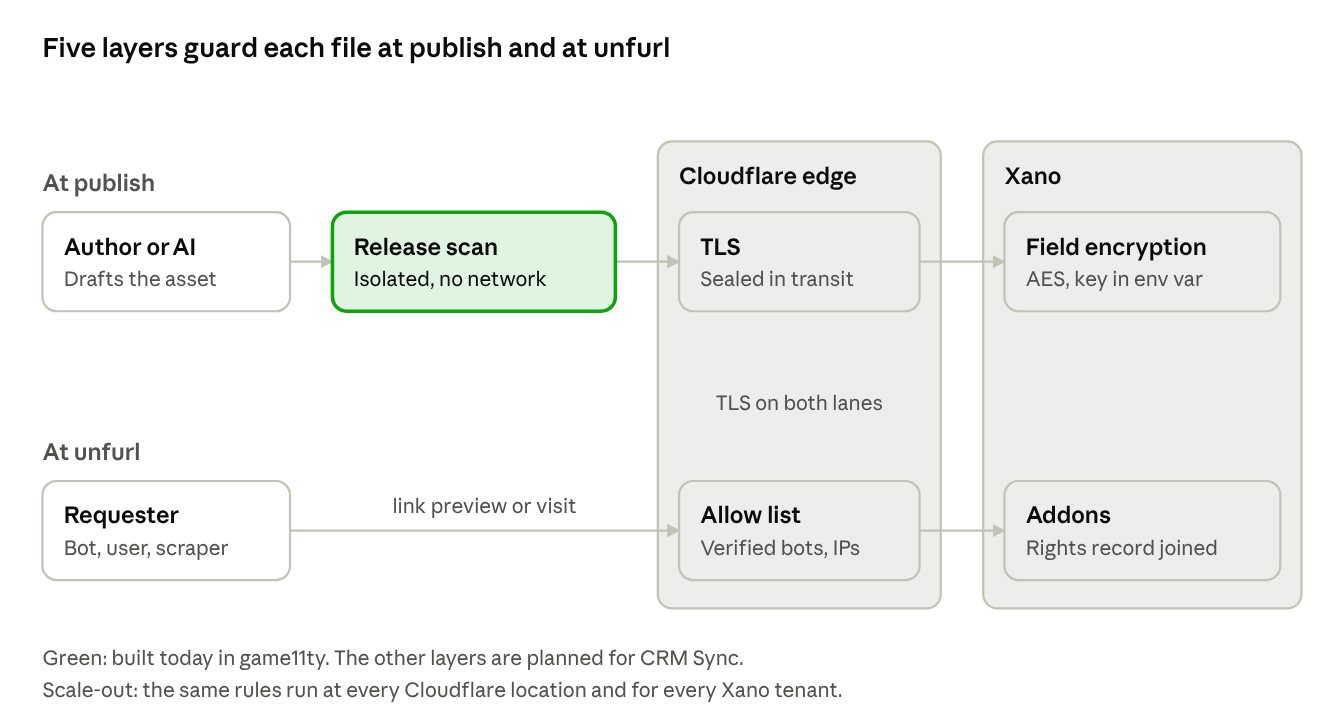
A file enters on the publish lane and is scanned before it reaches Cloudflare and Xano; a request enters on the unfurl lane and meets the allow list first.
Decision ladders
A decision ladder is a fixed set of questions asked in order. A file or request climbs one rung at a time and stops at the first "no", so every outcome has a known reason.
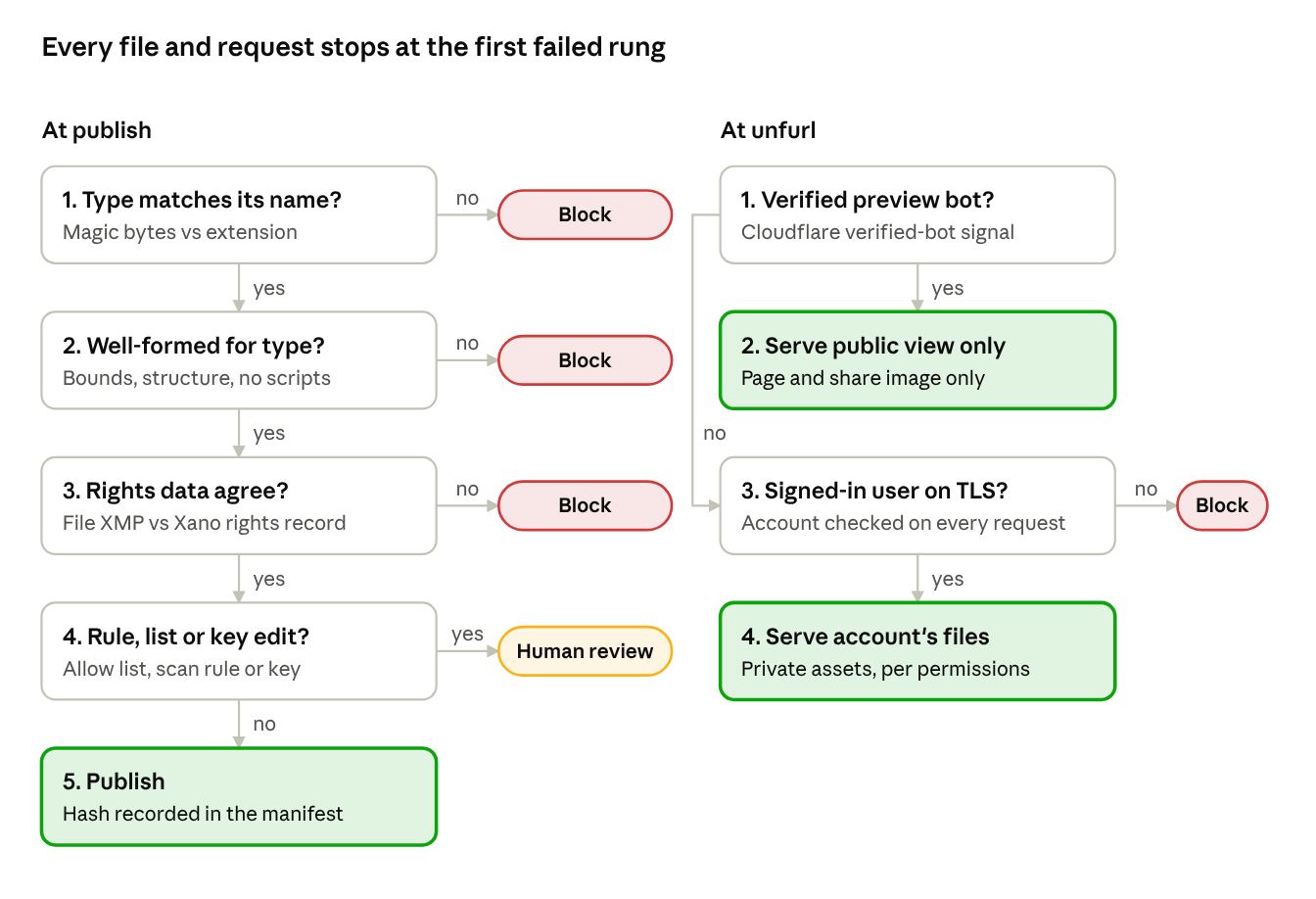
Green boxes are the only ways through; every other path ends at a block or a human review.
At publish:
- Does the file's real type (magic bytes) match its name? No → block.
- Is the file well-formed for that type: bounds, structure, no active content? No → block.
- Does it carry rights data, and do the Xano rights record and the file agree? No → block.
- Did this release change a rule, an allow list or a key? Yes → hold for human code review.
- Publish, and record the file's hash in the manifest.
At unfurl:
- Is the request on the allow list as a verified preview bot (Slack, Apple, LinkedIn, X), checked with Cloudflare's verified-bot signal, not just the name it claims? No → go to rung 3.
- Serve the public page and its share image only. Nothing private, no originals.
- Is it a signed-in user over TLS? Yes → serve what their account allows. No → challenge or block.
The ladders run the same way at every Cloudflare location, so adding servers or customers adds no new rules to maintain.
User stories and tests (TDD)
Each story is written with its test first, in test-driven development (TDD) style. The code is done when its tests pass.
| Story | Given | When | Then |
|---|---|---|---|
| As a publisher, I want mislabelled files stopped | A PNG named .jpg |
It is published | The release is blocked and the report names the file |
| As a rights owner, I want my claim on every copy | An asset with a Xano rights record | Any API returns it | The rights record is attached through an Addon |
| As a brand, I want link previews to work | A verified Slack preview bot | It fetches the article | It gets the page and share image, nothing else |
| As a security lead, I want scrapers kept out | A bot that only claims to be Slackbot | It fetches an original asset | It is challenged or blocked |
| As an operator, I want sensitive fields unreadable | A licence contact field in Xano | Someone reads the raw table | They see ciphertext, not the value |
Code review gates
AI can draft any change. A person approves the ones that change who gets in or how data is locked:
| Change | AI may | Human must |
|---|---|---|
| New asset or article | Draft and run the scan | Nothing extra if the scan passes |
| Scan rule | Draft the rule and its test | Review and approve |
| Allow list entry | Propose it with evidence | Approve; entries expire and are re-reviewed |
| Encryption key or algorithm | Never | Rotate keys and approve |
| Rights record | Draft from file metadata | Confirm the owner |
Keep the spec, its tests and the review record in the repository next to the code, so every change can be traced to a story, a test and an approver.
Magic bytes across CRM Sync: Shopify, WordPress, Webflow and Xano
In CRM Sync, the magic-byte check belongs in one place: the Cloudflare Worker that every upload and every file request already passes through. Not in a Shopify theme, a WordPress theme, a Webflow template or a page script. That makes the protection theme-agnostic: a merchant can switch Shopify or WordPress themes or redesign a Webflow site, and every file is still checked, because the check never lived in the theme.
In plain words: the theme decides how a file looks on the page. The Worker decides whether the file is allowed to exist and how it is labelled when it's served. Keeping those apart means a design change can't switch security off.
Upload path, the same for every platform:
- A file arrives at the Worker: from the Shopify app, a WordPress plugin, a Webflow Designer extension, or a Xano admin screen.
- The Worker reads the first bytes and detects the real type. The type must be on that destination's allow list, e.g. images and GLB for products, PDF for documents. Executables are never allowed.
- The Worker records the detected type, the SHA-256 hash and the rights fields in the asset's Xano row, with sensitive fields encrypted.
- Only then does the Worker request an upload slot from the platform. Shopify and Webflow upload in two steps and WordPress in one; either way the check runs before anything reaches them, and the file name's extension is set from the detected type, never the original name.
- When the file is served through Cloudflare, the Worker sets
Content-Typefrom the recorded type and addsX-Content-Type-Options: nosniff, so browsers trust the checked label instead of guessing. That's the header GitHub Pages doesn't send for game11ty.
Forms have MIME types too. An HTML form declares how it sends data in its enctype, which is itself a MIME type:
| Form encoding (MIME type) | Used for | What to trust |
|---|---|---|
application/x-www-form-urlencoded |
Plain text fields; the default | Validate each field's value |
multipart/form-data |
Any form with a file upload | Each file part carries its own Content-Type, guessed by the browser from the file name. It's a label from the uploader, so the Worker ignores it and reads the magic bytes |
text/plain |
Rare; debugging | Treat as untrusted text |
application/json |
fetch() calls from apps and extensions, not HTML forms |
Validate against a schema |
So the Worker checks the request's form type first, then each file part's real bytes. A part labelled image/png that starts with MZ is rejected, whatever the form said.
| Platform | Where files enter | Upload steps | What the Worker controls |
|---|---|---|---|
| Shopify | App, Admin API | Two: stagedUploadsCreate, then fileCreate |
The bytes and type before a staged target is requested |
| WordPress | Plugin, REST API | One: POST /wp-json/wp/v2/media, file in the body, name in Content-Disposition |
The file name and Content-Type sent with the upload |
| Webflow | Designer extension, Data API | Two: create asset (file name and MD5), then upload to a presigned URL | The file name's extension and the hash Webflow checks |
| Xano | Admin screens, API | Stores the asset row | Detected type, hash, rights record (Addon), encrypted fields |
| Cloudflare | Every request | Not applicable | Content-Type, nosniff, allow list, TLS |
Plain POST and GET to Xano. Between the Worker and Xano there's no SDK or extra security vendor, just HTTPS requests: POST to send data such as uploads and rights records, GET to read it. Xano is still a hosted service, so the security comes from what each endpoint enforces: sign-in, input checks, Addons and encrypted fields. Two rules keep it safe. Never put secrets or personal data in a GET URL, because servers and browsers log URLs; send them in a POST body. And keep the Xano API key in the Worker's secrets, never in a theme or page script, so it stays protected whatever theme or site builder is in front.
Design to theme: one backend for every template engine
The Worker and Xano sit below the template layer. Whether a page is built with Liquid, PHP, Astro or React, the template only produces HTML and URLs; the checks, allow list, encryption and rights records all run in the Worker and Xano over HTTPS. Swap the front end and the backend rules stay the same. What changes is when each front end talks to the Worker, and where its secrets must live:
| Front end | Template engine | When pages render | How it reaches the Worker | Keep secrets in |
|---|---|---|---|---|
| Shopify | Liquid | Every request, on Shopify's servers | Liquid can't make HTTP calls, so through an app proxy: Shopify forwards a store URL to the Worker with a signature the Worker verifies, and a reply sent as application/liquid renders inside the theme. Or browser calls |
Worker secrets only; nothing in the theme |
| WordPress | PHP templates and blocks | Every request, on the WordPress server | Server-side with the HTTP API (wp_remote_get, wp_remote_post), or browser calls |
wp-config.php or server environment, never theme files |
| Jekyll | Liquid | Once, at build time | The build fetches and bakes data in; browser calls for live data | Build environment; never in the _site/ output |
| Eleventy | Liquid, Nunjucks and others | Once, at build time | Data files fetch at build; browser calls for live data | Build environment; never in the output |
| Astro | Astro components | At build by default; per request with server rendering | Fetch in the component script at build or request time; browser calls | Unprefixed variables; anything named PUBLIC_ reaches the browser (Astro) |
| Next.js | React | At build, or per request with server components | Server-side fetch; browser calls | Unprefixed variables; anything named NEXT_PUBLIC_ is written into the browser bundle (Next.js) |
The rule is the same in every row: the Worker's URL can appear in a template, but its keys never do. One caution for the build-time front ends (Jekyll, Eleventy, static Astro and Next.js): data fetched at build is frozen into the HTML until the next build. Anything that must stay current or private, such as a rights change or a signed-in user's files, should be fetched live through the Worker, not baked in.
Head code: in the theme, or a higher-order function in the Worker
Head code is everything placed in a page's <head>: scripts, tracking tags, a content security policy, meta tags. The usual place for it is the theme: Shopify's theme.liquid, WordPress's header.php, Webflow's custom-code box, an Eleventy or Jekyll layout. The security best practice is to keep only the look there and move security into a higher-order head function in the Cloudflare Worker.
In plain words: a higher-order function is a function that wraps another one. The Worker's head function takes whatever page the origin sends, from any platform, and returns it hardened: security headers set and the security baseline script added. It's the same idea as Helmet, the Express middleware that sets headers such as Content-Security-Policy and Strict-Transport-Security, but at the edge and for every platform at once.
| Head code in the theme | Higher-order head function in the Worker | |
|---|---|---|
| Where it lives | Inside each theme or template | One function at the Cloudflare edge |
| Who can change it | Anyone with theme or design access | Only a reviewed Worker deploy (the code review gates) |
| Theme switch or redesign | Lost, or copied by hand into the new theme | Unaffected |
| Security headers | Only as <meta> tags, and some (frame-ancestors, HSTS) don't work that way |
Real HTTP headers on every response |
| Same on Shopify, WordPress, Webflow, Astro, Next | No: a separate copy per platform | Yes: one source |
| Secrets | Easy to paste in by mistake, and public once there | Stay in the Worker's secrets |
In the Higher-Order Stack, the layering CRM Sync is built on, this is a clean split of layers. The theme head carries Layer 2, the per-brand look: theme.css, fonts, brand tokens. The Worker carries Layer 1, Tier A, the always-on regulatory baseline: security headers, the consent gate and the integrity-checked loader that brings in Tier B scripts only where they're needed. It runs on every page and fails closed.
A sketch of the head function. It's an illustration of the pattern, not the CRM Sync code:
// Higher-order: wraps any fetch handler and returns a hardened response.
const withHead = (handler) => async (request, env, ctx) => {
  const res = await handler(request, env, ctx)
  const out = new Response(res.body, res)
  const nonce = crypto.randomUUID()
  out.headers.set("Content-Security-Policy", `default-src 'self'; script-src 'self' 'nonce-${nonce}'; frame-ancestors 'none'`)
  out.headers.set("Strict-Transport-Security", "max-age=31536000; includeSubDomains")
  out.headers.set("X-Content-Type-Options", "nosniff")
  out.headers.set("Referrer-Policy", "strict-origin-when-cross-origin")
  if (!out.headers.get("content-type")?.includes("text/html")) return out
  return new HTMLRewriter()
    .on("head", { element(el) {
      el.append(`<script src="/embed/stack-loader.js" nonce="${nonce}"></script>`, { html: true })
    } })
    .transform(out)
}

export default { fetch: withHead((request) => fetch(request)) }
Cloudflare's HTMLRewriter edits the HTML as it streams, so the theme never needs to know the baseline exists.
Where the Worker can't sit in front. Shopify doesn't support a Cloudflare proxy in front of a storefront domain; records pointing to Shopify must be DNS-only (Cloudflare community). There, the Worker hardens everything it serves itself (the app proxy route, embeds, APIs and files), and the theme head shrinks to a single loader tag. Check each host's proxy policy before relying on the Worker for its pages.
This part of the spec isn't built or checked against the CRM Sync code yet; it describes where the check should sit.
9. Connected devices: the machine plane
A connected product, such as a household thermometer or a printer's ink monitor, adds a fourth plane to the client, server and commerce planes: the machine, with its own network identity. Commerce, theme and server security don't protect it, and it can't protect them. Like section 8, this is a plan for CRM Sync; the parser below is the working reference.
| Plane | Where it runs | Who controls it | What protects it |
|---|---|---|---|
| Client (theme) | The shopper's browser | Anyone; it's fully public | Nothing it does is trusted. Look only, no secrets |
| Commerce | Shopify | Shopify | Shopify's own security; Functions in their WebAssembly sandbox |
| Server | Cloudflare Worker + Xano | You | Allow list, TLS, field encryption, release scan, edge head function |
| Machine | The device, in someone's home, on their network | You ship the code; the owner holds the hardware | Memory-safe firmware, secure boot, signed updates, a unique identity per device |
In plain words: after a device ships, you can't see or reach the hardware. Anyone can open it, read its memory or send messages pretending to be it. So the server treats every reading as untrusted input, exactly like an uploaded file.
What Shopify covers, and what's additional
| Feature | Built into Shopify? | What you add |
|---|---|---|
| Shopify Functions (discounts, shipping, payment, checkout validation) | Yes: WebAssembly, with Rust as a first-class language (Shopify) | Nothing. But a Function only sees the cart data Shopify sends it (at most 128 kB); it can't receive a file or run on a device |
| 3D product media | Partly: GLB and USDZ only, converted and optimized by Shopify above 15 MB (Shopify Help) | A scan before upload, and the rights record kept in Xano, because a re-encode can drop embedded metadata |
| Mechanical 3D / CAD (STEP, IGES, STL, 3MF) | No | Your own pipeline: Worker, a sandboxed parser, Xano; a converted GLB for display |
| Machine firmware | No; Shopify can sell it, never run or check it | Device code, signing, secure boot, updates, entitlement-gated delivery |
What a connected device needs
- On the device: firmware in Rust
no_std(no operating system, no heap), with the chip's memory protection unit; secure boot so it only runs signed firmware; signed over-the-air updates. - A unique identity per device: never a shared key or default password. Cloudflare's mutual TLS checks a client certificate per device, built for hardware that can't sign in like a person (Cloudflare). One stolen device can be revoked without touching the rest.
- At the Worker: check every reading against a schema, reject values outside physical range, rate-limit and allow-list devices. A reading is a file.
- In Xano: readings stored with sensitive fields encrypted; owner, consent and entitlement joined through Addons.
- In commerce: the device never holds Shopify keys. It reports; the server decides.
Example: an ink monitor that reorders.
Printer ──mTLS──▶ Worker ──▶ Xano ──▶ rule ──▶ Shopify
 "ink 8%"       checks cert,   stores     ink < 10%,       order created
 (signed)       schema, range  reading    owner consented,  by the server
                               and owner  under spend cap
If the printer is compromised, the worst it can do is send a false low-ink reading; the order still needs the owner's consent and stays under the spending cap they set. The device triggers, the server authorizes, the person sets the limits. A household thermometer adds privacy: room temperatures over time can show when a home is occupied, so treat them as personal data, collect only what the feature needs, and encrypt them at rest.
Memory safety on real hardware
On a microcontroller, Rust's safety comes mostly from the compiler, at no run-time cost: ownership and borrowing stop use-after-free and data races; bounds-checked reads (slice.get()) return "nothing" instead of memory past the end; checked arithmetic stops size calculations from wrapping on 32-bit chips. Hardware registers are modelled as values that can be taken only once, unsafe is confined to a small hardware-access layer, and a panic halts or resets the device instead of running corrupted. Underneath, the chip's memory protection unit and a stack-overflow guard add hardware enforcement.
The reference implementation is a no_std parser for the GLB format, in firmware/glb-parse. It has no unsafe code and borrows its result from the input, with no copy or allocation:
#![cfg_attr(not(test), no_std)]   // no operating system, no heap

pub fn glb_json(data: &[u8]) -> Result<&[u8], GlbError> {
    if data.get(0..4) != Some(b"glTF") { return Err(GlbError::NotGlb); }
    if u32_at(data, 8)? as usize != data.len() { return Err(GlbError::LengthLie); }
    let len = u32_at(data, 12)? as usize;
    if data.get(16..20) != Some(b"JSON") { return Err(GlbError::NotGlb); }
    let end = 20usize.checked_add(len).ok_or(GlbError::LengthLie)?; // can't wrap around
    data.get(20..end).ok_or(GlbError::LengthLie)                    // can't read past the end
}
| Test | What a typical C parser risks | Result |
|---|---|---|
| Valid file | — | JSON returned |
Program bytes (MZ) instead of a model |
Parsed as a model | NotGlb |
| Empty input | Reads uninitialised memory | NotGlb |
| Header cut off | Reads past the end | Truncated |
| Header lies about total size | Trusts the lie | LengthLie |
| First chunk isn't JSON | Parses binary as JSON | NotGlb |
| Chunk claims one byte more than exists | Buffer overflow | LengthLie |
Chunk length 0xFFFFFFFF |
20 + len wraps to 19 on a 32-bit chip and passes the check |
LengthLie |
CI runs the 8 tests and a mutation check (5 of 5 mutants killed), then builds the same code for two targets: thumbv7em-none-eabihf, an Arm Cortex-M4/M7 microcontroller, and wasm32-unknown-unknown, for a Worker checking uploads. One codebase guards the device and the edge. Tools cover what the compiler can't: Miri finds undefined behaviour in unsafe code, Kani proves properties for every input, cargo-fuzz throws millions of mutated files at a parser, and cargo-geiger counts unsafe code in dependencies.
The limits: registers and C libraries still need unsafe, which Rust shrinks but doesn't remove; logic bugs and timing side channels aren't memory bugs; a C decoder linked into Rust keeps C's risks.
The law now covers these devices
- EU Cyber Resilience Act: since 11 September 2026, manufacturers must report actively exploited vulnerabilities and severe incidents, with an early warning within 24 hours and a full notification within 72. The full security requirements, CE marking and conformity assessment apply from 11 December 2027. Consumer IoT is in scope (European Commission).
- UK product security regime (PSTI): in force since 29 April 2024. Universal default and easily guessed passwords are banned, and smart thermostats and appliances are named as covered products; manufacturers, importers and retailers share the duties (GOV.UK).
Selling a connected thermometer or printer into the EU or UK makes device security a legal obligation, whether it's sold through Shopify or not.
10. Concurrency, permissions and regulated data: an AI-shaped design
This section is also a plan. It settles four questions every layer above has to answer the same way: what Rust can and can't prevent, where permissions live, where each class of regulated data may go, and how infrastructure changes when AI agents act inside it.
Governance model: four priorities
Older governance models were written for people signing in and for nightly or 15-minute batches: who may log in, who approves a change, where the backups go. When AI agents act inside the system, governance has to cover four things first, in this order. Each priority depends on the one before it: a permission check is only as good as the freshness of the data it reads and the protection against the same action running twice.
| Priority | The question it answers | The rule | Enforced by | Tests |
|---|---|---|---|---|
| 1. Real time | Is the data an action relies on current enough to act on? | Decide on the real-time path; every record carries occurred_at and recorded_at in ISO 8601 UTC; each action has a staleness tolerance; batch copies (15-minute ERP, nightly Clarity) are for reconciliation only |
Event streams and webhooks into the Xano ledger; freshness checks at evaluation | DH-08, DH-15, DH-16, DH-20 |
| 2. Race | Can the same action happen twice, or two actions collide? | Every action carries an idempotency key under a unique index; check-then-act is one conditional update; Rust ownership covers races inside one program | Database constraints in Xano; Rust's compiler on devices | DH-10 to DH-14 |
| 3. Permissions | Is this actor allowed to do this, right now? | Claims and entitlements live in the system of record and are re-checked per request; token extras, tags and synced fields are labels, never grants; revocation is a ledger entry, effective immediately | Xano claims, consent and caps, read on every high-stakes request | DH-04, DH-17, DH-18 |
| 4. Trust / boundary | What may cross from one trust zone to the next? | Classify data (PII, PCI, PHI) before it moves; shape it at each boundary (browser to Worker, Worker to model, Xano to vendor, device to cloud); the model is the least trusted reader; PHI crosses only to parties with a business associate agreement | The edge Worker, mutual TLS for devices, routing by data class and region | DH-01 to DH-03, DH-05 to DH-07, DH-19 |
The egress gate: refused before any bytes leave
Older pipelines checked data after it moved: logs were scanned, audits ran monthly, a leak was found and then reported. With AI agents sending data to models and vendors in seconds, that order is too late. The new rule inverts it: evaluate the bytes before they cross the trust boundary, and if the answer is no, nothing crosses and the refusal is recorded.
| Step | What happens to the bytes | What it checks |
|---|---|---|
| 1. Hold | The request body is buffered at the Worker; nothing is streamed onward yet | Size limits; the real type from magic bytes, not the name or header |
| 2. Classify | Each field's data class comes from its tag; free text is scanned for PII patterns and canary values | Untagged fields count as the most sensitive class until tagged |
| 3. Evaluate | The destination, data class, region and actor are checked against live records | A business associate agreement on file for PHI; consent and claim active; residency allowed; data fresh enough |
| 4. Decide | Allowed: the payload is shaped (IDs and derived facts) and sent. Refused: the buffer is dropped | — |
| 5. Record | Either way, a ledger entry: idempotency key, actor, destination, data class, decision, reason, ISO 8601 UTC time | The refusal itself is evidence, queryable like any other action |
How it's tested. Test DH-03 sends a canary payload tagged phi toward a destination with no agreement on file and asserts two things: the network capture shows zero bytes reached the destination, and the ledger holds one refusal row with its reason. In a browser, Playwright's request listener plays the network-capture role. A test that only checks the response code would miss a gate that refuses after sending.
The subsections that follow work through each priority: real time and race from data races through testing, permissions in claims and entitlements, and trust and boundaries in where each class may live and AI-shaped infrastructure. The test IDs refer to the data hygiene test requirements: 20 Given / When / Then tests, one per rule.
Data races and race conditions
Rust prevents one kind of timing bug and not the other.
| Data race | Race condition | |
|---|---|---|
| What it is | Two threads touch the same memory at once, at least one writing, with no coordination; memory is corrupted | The outcome depends on timing, even though memory stays safe |
| Example | A device's sensor task and network task write one buffer at the same time | Two "ink 8%" readings a second apart both trigger a reorder |
| Prevented by Rust? | Yes, at compile time. Ownership and the Send/Sync rules reject unsafe sharing |
No. It's logic across requests, often across machines |
| Who fixes it | The compiler | The database: an idempotency key with a unique index (one reorder per device per low-ink event) and conditional updates ("only if no open reorder exists") |
How ownership exclusion works
Rust's rule is aliasing XOR mutation: at any moment a value has either any number of readers (&T) or exactly one writer (&mut T), never both. Every value has one owner; passing it by value moves it, and the old name can't be used again. The compiler checks this before the program runs, which is why two tasks can't write one buffer at once: the second &mut doesn't compile.
The same exclusion also stops a common race condition inside one program, check-then-act, if the check and the act are made to need the same exclusive access:
use std::sync::Mutex;

struct Device { open_reorder: Option<ReorderId> }

/// A reservation can only be created by `reserve` and only used once.
pub struct Reservation { device_id: DeviceId }

fn reserve(device: &Mutex<Device>, id: DeviceId) -> Option<Reservation> {
    let mut d = device.lock().unwrap();      // exclusive: no one else can check or act
    if d.open_reorder.is_some() { return None; }   // check...
    d.open_reorder = Some(ReorderId::pending());   // ...and act, under the same lock
    Some(Reservation { device_id: id })
}                                            // lock released here, after both

fn place_order(r: Reservation) { /* takes ownership */ }

// place_order(r); place_order(r);  // error[E0382]: use of moved value `r`
- The lock guard is the only way to touch
Device, so the check and the write can't be split by another task. - The
Reservationis consumed by value: one reservation buys one order, and spending it twice is a compile error, not a runtime bug.
Where it stops: ownership lives in one process's memory. Two Workers, a retried request or a second agent each have their own copy, and the compiler can't see across the network. That's why the table puts the cross-request fix in the database. The idempotency key is the same idea as the Reservation, enforced by a unique index instead of the compiler.
AI agents make race conditions more common: they retry, run in parallel and repeat themselves. Every action an agent can trigger needs an idempotency key, so the second attempt is refused by the database, not by luck.
In brief: idempotency keys and the system of record
Problem. Networks fail, AI agents retry and streams deliver the same event more than once. Without protection, a retry looks like a new order, and two "ink 8%" readings become two reorders. At the same time, every system holds its own version of the facts: a token says an agent may buy, a cache says stock is available, a 15-minute SAP batch says something else. When they disagree, nothing says which one is right.
Challenge. Two questions need one answer each, every time: has this already happened? and what's true right now? An idempotency key answers the first. It's a unique ID for one intended action, such as reorder:{device_id}:{low_ink_event_id}, sent with the request and stored with its result under a unique index; a repeat with the same key gets the stored result back and nothing happens twice. A system of record (SoR) answers the second. It's the one system where a fact is first written, owned and kept with its history; every other system holds a copy, and when a copy disagrees, the system of record wins and the copy is corrected. The hard part is discipline: every agent, device and integration has to route its actions through the same keys and the same record, including the batch jobs that would rather write straight to their own copy.
Result. Xano is the system of record for claims, entitlements, consent, agent and device identities, reorders and agent actions; card data stays with Shopify's checkout and invoices with SAP. An agent's action counts only once it's recorded in Xano under its idempotency key. Retries return the first result instead of repeating it, a revoked permission is refused even when the agent's token still says yes, and reconciling any copy, an agent's view, a cache or a batch, is a comparison against one record rather than an argument between systems.
Idempotency, real-time streams and evaluation
Three terms carry the rest of this section.
Idempotency. An operation is idempotent when doing it twice has the same effect as doing it once. "Set stock to 12" is idempotent; "subtract 1 from stock" isn't. To make an action idempotent, the caller sends an idempotency key: a unique ID for the intent, such as reorder:{device_id}:{low_ink_event_id}. The server stores the key with the result. A repeat with the same key gets the stored result back and nothing happens a second time (Stripe).
Real-time data streaming. Each change is published as an event the moment it happens (a webhook, a queue message, a change-data-capture record) and consumers act on it within seconds. Streams deliver events at least once, sometimes out of order. That's why streaming and idempotency come as a pair: at-least-once delivery plus an idempotent consumer gives an effectively-once result.
Evaluation. Before an event causes an action, it's evaluated against current state: is the claim still valid, is consent still on, is the spending cap unspent, is the world still the way the event assumes (a conditional update on a version number)? For AI agents the same step scores the agent's decision against live data before it's allowed through. Evaluation is only as good as the freshness of what it reads.
| Step | What happens | What makes it safe |
|---|---|---|
| 1. Event | The device reports "ink 8%"; a webhook reaches the Worker with an event ID | Signed payload, event ID from the source |
| 2. Deduplicate | The Worker derives the idempotency key and inserts it | Unique index: a repeat is refused by the database |
| 3. Evaluate | Re-read claims, consent, cap, open reorders and stock | Read from current state, never from the event or a token |
| 4. Act | Create the reorder | Conditional update: "only if no open reorder exists" |
| 5. Record | Write the audit entry | The consent-aware event bus: which agent, for whom, under which claim |
When the integration layer runs every 15 minutes
Many ERP integrations, SAP behind Boomi, Celigo or MuleSoft, run as scheduled batches: a poll every 15 minutes, IDocs collected and sent by a background job, or EDI documents (850 purchase orders, 846 inventory, 856 ship notices) exchanged in batches through a trading partner. All three platforms can run on events, but the schedule is often set by something else: SAP's batch jobs, a partner's EDI window, or API and licence limits. When it is, the ERP's view trails the stream by up to 15 minutes, and anything that evaluates against it reads stale truth.
| What breaks | Example | Why |
|---|---|---|
| Evaluation reads stale state | An agent checks stock synced 14 minutes ago and promises the last unit; SAP sold it 12 minutes ago | Step 3 above is only correct if "current state" is current |
| Idempotency keys don't survive the hop | A batch map drops the event ID; a failed run is retried and SAP creates every sales order twice | The real-time layer refused duplicates; the ERP never saw the key |
| Order collapses | A reorder and its cancellation, three minutes apart, land in one batch and are applied in file order, not event order | Batches sort by arrival, not by when things happened |
| Revocation lags | Consent is withdrawn or a refund issued at 10:01; the entitlement synced from SAP changes at 10:15 | For 14 minutes an agent can act on a revoked right: the same snapshot problem as token extras |
| Agents amplify the gap | No confirmation for 15 minutes, so the agent retries, or a second agent acts on the same signal | The pending state is invisible to anyone outside the batch |
| Regulated data piles up | Each batch is a file of full customer records waiting on SFTP or in a staging table | A batch is a copy: it widens where PII lives and must be classified like any store |
The pattern survives if the batch is demoted from authority to reconciliation:
- Decide on the real-time path, reconcile on the batch. Revocable and high-stakes checks read Xano claims and the Xano ledger below, fed by Shopify webhooks. The 15-minute feed corrects and reports; it never grants.
- Carry the idempotency key end to end. Map it into a unique external reference in SAP, so a replayed batch is refused there too, not just at the Worker.
- Stamp freshness and set a tolerance per action. Every synced record carries an
as_oftime. Evaluation refuses, or climbs the decision ladder to a human, when the data is older than the action allows: seconds for selling the last unit, minutes for a catalogue description. - Reserve, then confirm. Hold a reservation in the real-time layer when the decision is made; the batch confirms or releases it. Show the agent "pending" so it doesn't retry.
- Move the hot paths onto events. Stock, price, order status and consent belong on events: IDocs set to send immediately rather than collected, SAP's event mesh, Boomi Event Streams, MuleSoft Anypoint MQ or Celigo's real-time listeners. Keep EDI batches for documents a partner batches anyway.
The rule of thumb: a 15-minute feed can tell you what happened; it can't tell an agent what's true now.
The same gap in healthcare: Epic
Epic isn't SAP. Epic Systems makes electronic health records; SAP makes business ERP software. A hospital often runs both: Epic for the clinical chart, SAP (or Oracle or Workday) for finance, payroll and supply chain. The data gap has the same shape in Epic, with a different interval. The chart itself is real time; the lag appears where data is copied out, and the largest copy is usually nightly.
| Epic layer | What it is | Freshness |
|---|---|---|
| Chronicles | The operational database clinicians chart into | Real time: Epic's system of record for the chart |
| HL7 v2 interfaces | Admissions, orders, results and messages to and from labs, devices and other systems | Mostly real time, one message per event; some feeds are batched, depending on the site |
| FHIR and other APIs | What apps and AI tools call | Read from Chronicles, near real time |
| Clarity | SQL reporting database extracted from Chronicles | Usually refreshed nightly: up to about a day behind |
| Caboodle | Data warehouse built from Clarity and other sources | Nightly or slower |
| Bulk FHIR export | Population-level exports | Batch, on a schedule |
So the risk in Epic is yesterday's data, not the last 15 minutes. An AI agent, an analytics job or a consent check that evaluates against Clarity can act on facts up to a day old: a new allergy, a stopped medication, a withdrawn consent. Integration engines around Epic can add their own polling delay, just as Boomi, Celigo or MuleSoft do in front of SAP. Refresh schedules vary by health system, so check each site's setup rather than assuming one.
The pattern still holds, with Epic in Xano's place for clinical facts: Chronicles is the system of record, decisions read it through live APIs or event feeds, and Clarity is for reconciliation and reporting only. Everything an agent sees from it is PHI, so it may reach only vendors and models covered by a business associate agreement.
Xano as system of record: a timestamped ledger
One system has to be the answer when two disagree.
System of record (SoR). The one system where a fact is first written, owned and kept, with its history. Every other system holds a copy. When a copy and the system of record disagree, the system of record wins and the copy is corrected. A fact has exactly one system of record; a system can be the record for some facts and a copy for others.
Source of truth. The system every decision reads from. Here it's the same system as the record, on purpose: if agents evaluated against a copy, a permission could be granted on data the record has already changed.
| Role | Definition | Who plays it here |
|---|---|---|
| System of record | Writes, owns and keeps the history of a fact | Xano, for claims, entitlements, consent, agent and device identities, reorders and agent actions |
| Source of truth | What evaluation reads before any action | Xano, the same tables, read per request |
| System of engagement | Where people or agents start an action | Shopify storefront and checkout, Webflow, devices, AI agents |
| Copy | Holds a synced or cached version for speed or reporting | Token extras, Worker caches, Shopify tags and metafields, SAP via the 15-minute batch, vector stores |
Some facts have a different system of record: card data belongs to Shopify's checkout and never enters Xano; the general ledger and invoices belong to SAP. Xano holds references to those, not the facts themselves.
Why the definition matters for reconciliation. An agent's view and a permission can each drift: the agent holds a token, a cached entitlement or a fact it was told minutes ago, while the claim in Xano has changed. Reconciliation means comparing each copy to the system of record and resolving the difference one way, always in the record's favour:
| Agent's copy says | Xano says | Result |
|---|---|---|
| Allowed (token extras, cache) | Claim revoked, consent withdrawn or cap spent | Refused. The agent's copy is invalidated and the refusal recorded |
| Not allowed, or unknown | Claim active | Evaluate normally; refresh the agent's copy |
| Action done (it got no confirmation, or it retried) | Idempotency key already in the ledger | Return the stored result; nothing happens twice |
| Action done | No ledger entry | It didn't happen. The agent must submit it through Xano |
| Fact from a 15-minute batch | A newer entry by occurred_at |
The newer entry stands; the batch difference is flagged, not applied |
Shopify, SAP, Webflow, the Worker and every AI agent hold copies or send requests; none of them is the authority for claims, consent, entitlements, reorders or agent actions.
Xano keeps that authority as a ledger: an append-only table of events, never edited or deleted, from which current state is derived.
| Field | Format | Why |
|---|---|---|
id |
Sequential ID assigned by Xano | Total order inside the system of record |
idempotency_key |
Unique index | A repeat from a retry, a replayed batch or a second agent is refused here |
occurred_at |
ISO 8601 in UTC, e.g. 2026-10-05T14:03:27.412Z |
When it happened at the source: used to order events |
recorded_at |
ISO 8601 in UTC, set by Xano | When the system of record learned of it: the gap to occurred_at is the latency, so a 15-minute batch shows up in the data |
source |
shopify_webhook, sap_batch, agent:{id}, device:{id} |
Who said so |
actor / on_behalf_of |
Agent, device or user ID; the owner it acts for | Agents are principals, never borrowers of a person's credentials |
claim_id |
Reference to the entitlement checked | Which right allowed it, at that moment |
event_type / payload |
Controlled list; IDs and derived facts, not raw PII | The ledger is long-lived: minimise what goes in |
region, currency, language |
ISO 3166-1, ISO 4217, ISO 639 / BCP 47 codes | A shared register of codes, so GB, GBP and en-GB mean the same thing in Xano, SAP, Shopify and an agent's prompt |
data_class |
none, pii, phi (never pci) |
Residency and model routing are decided per class |
reverses |
ID of the entry it corrects | Mistakes are fixed with a new entry, never by editing history |
The guideline for code, AI agents and permissions pipelines:
- Write to the ledger first, then act. An action that isn't in the ledger didn't happen. Agents and code call a Xano endpoint that records the intent with its key, evaluates, and only then creates the order, download or rights change.
- Read permissions from Xano, not from copies. Token extras, glTF extras, Shopify tags and SAP fields are labels. The permission check reads the claim in Xano on every high-stakes request.
- Timestamps are ISO 8601 UTC, always. No local times, no epoch numbers in one system and strings in another. Order by
occurred_at; measure staleness withnow - recorded_at; refuse when it exceeds the action's tolerance. - Codes come from ISO registers. Region, currency and language are ISO codes validated on write; free text like "UK" or "pounds" is rejected, so agents can't invent values.
- Copies are reconciled against the ledger, not the other way round. A 15-minute SAP batch is recorded as entries with
source: sap_batch; where it disagrees with what Xano already recorded, the difference is flagged for review, not overwritten. - Revocation is an entry. A withdrawn consent or a refund is appended the moment it's known and takes effect on the next evaluation, with no wait for a token to expire or a batch to run.
- Audit is a query. "Which agent, acting for whom, did what, under which claim, with which data class" is a read of the ledger, not a forensic exercise across logs.
Permissions: claims and entitlements, not token extras
Xano's authentication tokens are encrypted JWE tokens, and their extras can carry data such as a user's role (Xano). Extras are written when the token is created and last until it expires, so they're a snapshot.
| Use | Where it lives | Why |
|---|---|---|
| Fast, low-risk checks: role for the interface, tenant, plan tier | Token extras | No lookup per request; encrypted, so the client can't read or change them |
| Anything revocable or high-stakes: orders, payments, firmware downloads, rights changes | Claims and entitlements in Xano tables, re-checked on every request | A refund or a withdrawn consent can't be pulled back out of an issued token |
| Device and agent actions | The device or agent record, the owner's consent and the spending cap, checked per request | A device or agent token never carries purchase rights by itself |
glTF extras (game-object IDs, SKUs) |
The model file | Written by whoever edits the file: fine as a label, never a permission |
Testing the pipeline: data, code and agents
Challenge. Browser testing and EDI used to be enough. A Selenium script clicked through checkout, the page worked, and an EDI batch carried the order to SAP within 15 minutes. People were the only ones acting on the data, at human speed, and a short delay or an untested log line rarely mattered. AI changes all three: agents act on data in seconds, run in parallel and retry on their own; they read whatever data reaches them, including what leaked into a prompt or a log; and their decisions are only as good as the freshness of what they read. A test that only asks "does the page work?" can pass while an agent oversells stock, acts on a revoked consent or sends PII to a model. The testing and evaluation process has to change with it: test the data as well as the code, prove where regulated values go, attack the system on purpose, and escalate to a human where the stakes call for it.
The rules above only hold if something proves them on every change. Testing here has two targets: the code, and the data the code moves.
Why test your data, not just your code. Code tests pass while the data is wrong. A field loses its class tag, a sync writes local time instead of UTC, a batch replays without its key, a copy drifts from the system of record. Nothing crashes, so no code test notices. AI agents make this worse: an agent acts on whatever data it's given, with confidence. And regulators judge where the data went, not what the code intended. Data tests check the facts themselves: every field classified, every timestamp ISO 8601 UTC, every key unique, every copy reconciled, no regulated value anywhere it shouldn't be.
Kinds of test
| Kind | What it is | Example here | Catches |
|---|---|---|---|
| Unit test | Tests one function on its own, with no network or database; runs in milliseconds | isIsoUtc("2026-10-05T14:03:27Z") is true; "UK" fails the region check |
Logic errors in a single rule |
| Integration test | Tests real parts working together (Worker, Xano, Shopify test store) in a test workspace | The same idempotency key sent 20 times in parallel creates one order and one ledger row | Gaps between systems: indexes, permissions, retries |
| Canary test | Plants a clearly fake marker value, runs a real flow, then searches everywhere it must not appear | Card 4242 4242 4242 4242 and canary+dh@example.com go through checkout; neither appears in Xano, logs, prompts or vector stores |
Leaks nobody designed: a debug log, a third-party script, a prompt that pulled a whole record |
| End-to-end (browser) test | Drives a real browser through the site as a visitor would | With consent declined, no analytics or AI request leaves the page | What actually happens in the browser, including third-party scripts |
| Adversarial test | Generates hostile or unusual inputs on purpose and checks the system refuses them | Prompt injection in a product review, "pounds" as currency, a stale entitlement, a replayed batch |
Cases the author didn't think of |
The name canary comes from the birds miners carried to detect gas before people could. A canary value is safe to use often, because it can never be real customer data, and it turns "card data never touches our systems" from a claim into evidence. Run canaries in a test workspace, never against production records. (A canary release, shipping to a small share of traffic first, is a different practice with the same name.)
TDD, with an adversary
Test-driven development (TDD), as in the user stories above, writes the test first and the code until it passes. Its weakness is that the same author writes both, so the tests only cover what the author imagined.
Adversarial testing adds an opponent. The idea borrows from a GAN (generative adversarial network), where a generator tries to fool a discriminator and both improve. Here it's a loop, not a trained network:
- Generator. An AI agent is asked to break a rule: produce inputs that should be refused (injected instructions, malformed ISO codes, duplicate retries, stale data, PII hidden in free text, an agent claiming a right it doesn't have).
- Discriminator. The system under test, plus the checks above, decides: refused correctly, or let through.
- Learn. Every input that got through becomes a new failing test, TDD style. The code is fixed until it passes, and the test stays as a regression guard.
- Repeat on each release, so the generator keeps looking for the next gap.
The generator runs in a test workspace with canary data only. It's a tool for finding gaps, not an authority: what it finds is reviewed like any other bug report.
AI escalation: when a human reviews
AI can write tests, run them and review code. It shouldn't be the last word on changes that alter who gets in, where regulated data goes, or what an agent may buy. Review climbs a ladder, like the decision ladders above, and stops at the first rung that's enough:
| Rung | Who reviews | Enough for |
|---|---|---|
| 1. Automated tests | Unit, integration, canary and browser tests in CI | Content, copy, styling: changes that touch no rule |
| 2. AI review | An AI reviewer reads the diff against the data hygiene checklist and the test results | Ordinary code changes with passing tests |
| 3. AI + human | The AI flags; a person approves | New fields or data flows, new agent tools, integration mappings, freshness tolerances |
| 4. Human only | A named person decides; AI may draft, never approve | Permissions, claims and caps; consent logic; anything touching PHI or card data; keys and encryption; the system-of-record map |
Escalate automatically when a change touches a classified field, a permission check or a model call, when a canary or adversarial test fails, or when the AI reviewer's confidence is low. The review record (which rung, who, which tests) goes in the ledger with the change.
Selenium or Playwright
Both drive real browsers for end-to-end tests. Selenium is the long-standing standard, built on the W3C WebDriver protocol, with the widest range of languages, browsers and existing test suites. Playwright, from Microsoft, is newer and built around how modern sites behave.
| Selenium | Playwright | |
|---|---|---|
| Protocol | W3C WebDriver (WebDriver BiDi being added) | Talks to browsers directly over their own protocols |
| Browsers | Chrome, Firefox, Safari, Edge, plus older browsers and large device grids | Chromium, Firefox and WebKit (Safari's engine), bundled and version-matched |
| Waiting | Explicit waits written by hand; a common source of flaky tests | Waits automatically until an element is ready |
| Network | Limited without extra tools | Intercept, block, inspect or fake any request (page.route) |
| Isolation | One browser profile per session | Many isolated browser contexts in one browser: separate users, cookies and storage, run in parallel |
| Evidence | Screenshots; video and logs via add-ons | Built-in trace viewer: every action, request, console message and DOM snapshot |
| Best fit | Large existing suites, legacy browsers, many languages | New suites for modern sites, and tests about data leaving the browser |
Why Playwright here. The tests that matter most in this design are about data in motion, and Playwright can watch the network:
- Consent before egress. With consent declined, assert that no request goes to analytics, ad or AI hosts, by listening to every request the page makes.
- Canaries in the browser. Type the canary email into a form, then assert it appears in no outgoing request except the one allowed endpoint, and in no URL.
- Several principals at once. Separate contexts act as a customer, a second customer and an agent in the same test, which is how permission and idempotency races are reproduced.
- Evidence for review. The trace is attached to the review record, so a human at rung 3 or 4 sees exactly what happened.
- Already in the stack. The Hydrogen projects ship with Playwright, and AI agents can drive it directly, so the same tool serves CI and agent-run checks.
Selenium remains the right choice where a team already has a large WebDriver suite or must cover browsers Playwright doesn't ship.
PII, PCI and PHI: where each class may live
Classify data before designing where it flows. The class decides which systems may hold it, not convenience.
| Class | What it is | Examples here | May live in | Must never be in | Key controls |
|---|---|---|---|---|---|
| PII (personal data) | Anything that identifies a person: GDPR, CCPA, and state health-data laws | Name, email, address, device owner, a home's temperature history | Xano, in encrypted fields; Shopify customer records | Logs, URLs, token extras beyond an ID, themes, AI prompts beyond what the task needs | Minimise, consent, encrypt at rest, access by claim, deletion on request |
| PCI (cardholder data) | Card number, security code, track data, under PCI DSS v4.0.1 | Card details at checkout | Only the payment provider's checkout (Shopify's), which hands back tokens | The Worker, Xano, logs, AI, devices: anywhere you control | Stay out of scope: never touch card data. The simplest assessment (SAQ A) now requires confirming your site isn't open to malicious scripts (PCI SSC), which the edge head function's CSP supports |
| PHI (health information under HIPAA) | Health information held by a covered entity or its business associate | A clinic's patient readings | Only vendors with a signed business associate agreement: Xano offers one on Enterprise plans (Xano); Cloudflare signs one for Enterprise customers, for listed services (Cloudflare) | Shopify: it signs no agreement, and its acceptable-use policy prohibits PHI (HIPAA Journal). Any AI model without an agreement | Agreement first, then encryption, audit logs, minimum necessary access |
A consumer thermometer sold directly to households is usually not HIPAA PHI, because the seller isn't a covered entity. Its readings are still consumer health data: Washington's My Health My Data Act has required consent for collecting and sharing it since 31 March 2024 (Goodwin), and the FTC's Health Breach Notification Rule covers health apps and devices outside HIPAA (FTC). Design it as PII with health-grade consent.
AI-shaped infrastructure
Infrastructure as a service was designed for people and programs. When AI agents act inside it, two things change: the agent becomes a principal with its own identity, and data has to be shaped before it reaches a model.
| Concern | Traditional infrastructure | AI-shaped infrastructure |
|---|---|---|
| Identity | People sign in; services hold API keys | Each agent has its own identity and claims, like a device: never a person's credentials, revocable on its own |
| Permissions | Role-based, checked at sign-in | Checked per tool call against Xano entitlements and caps; high-stakes actions climb the decision ladder to a human |
| Data to the model | Not applicable | Shaped at the Worker: IDs and derived facts ("ink low: yes"), never raw PII; card data never; PHI only to a model provider with a business associate agreement and no data retention |
| Data stores | Databases and files | Also prompts, outputs, logs, caches and vector stores. Classify them all: personal data in embeddings is hard to find and delete, so store pseudonymous IDs there |
| Retries and parallelism | Occasional | Constant: idempotency keys on every action |
| Audit | Who logged in | Which agent, acting for whom, called which tool, with which data class, under which claim. This is the consent-aware event bus of the Higher-Order Stack |
| Residency | Per application | Per data class and region, routed at the Worker before any model call |
The rule of thumb: the model is the least trusted reader in the system. Give it the smallest shape of data that lets it do the job, and let the server, not the model, hold the keys.
Recent cases, 2025–2026
The AI privacy cases in healthcare so far aren't about models being hacked. They're about consent, vendors and staff behaviour. The lawsuits below are allegations, not findings.
| Case | What happened | Lesson | Rule |
|---|---|---|---|
| Sharp HealthCare, lawsuit filed 26 November 2025 in San Diego | Alleged: an ambient AI scribe (Abridge) recorded patient visits without consent, sent recordings to outside servers, and wrote chart notes falsely stating patients had consented; plaintiffs estimate over 100,000 encounters (Becker's) | Consent is an event captured at the moment of recording. Software may record it, never assert it | SB-21 |
| Sutter Health and Memorial Healthcare Services, lawsuit filed 14 April 2026 in federal court | Alleged: the same tool recorded conversations without proper consent and sent the audio out for processing, under California's wiretap and medical-confidentiality laws and the federal Wiretap Act. HIPAA isn't claimed: the vendor works under business associate agreements (HIPAA Journal) | A business associate agreement is necessary but not enough: state consent and wiretap laws apply too | SB-21 |
| HCIactive, breach July 2025 | A hacker copied files from an "AI-powered" health-plan administrator; the count reported to HHS grew from 501 to 3,056,950 people by January 2026, with Social Security numbers and medical records exposed (The HIPAA E-Tool). The cause was ordinary hacking, not the AI | One vendor serving many clients concentrates millions of records: send vendors IDs and derived facts, not full records | SB-22 |
| Shadow AI, Netskope 2025 healthcare report | 71% of healthcare workers still use personal AI accounts for work, and 81% of data-policy violations involved regulated data such as PHI (Medical Economics) | Route AI through approved providers at the Worker, and test with canary values | SB-22 |
HHS's Office for Civil Rights, which enforces HIPAA, has made the vendor rule plain: covered entities can't hand their HIPAA duties to an AI vendor, the business associate agreement comes before the service starts, and if the vendor is breached the provider still notifies patients. A missing risk analysis is still the most-cited failure (HIPAA Journal).
The same lesson reaches the household thermometer, outside HIPAA: capture consent before the data is collected, and keep the proof on the server.
11. Rights metadata as lightweight DRM
XMP rights fields don't lock an image; they declare who owns it and on what terms, in a form machines act on. Real DRM encrypts content. Rights metadata is closer to a label that travels with the file: it can be stripped, but a crawler, DAM or training pipeline that respects it can read the terms without a human.
What each machine does with it:
- Google Images shows a Licensable badge when an image has a Web Statement of Rights (
xmpRights:WebStatement). It also reads Creator, Credit Line, Copyright Notice, Licensor URL and Digital Source Type. Where XMP and the page's structured data disagree, Google uses the structured data (Google Search Central). - AI and data-mining pipelines can read
plus:DataMining. Its controlled values include Prohibited, Allowed, and Prohibited except for search engine indexing, which the IPTC says rules out other uses such as AI/ML training (IPTC 2025.1). - DAMs index the full packet, so rights and usage terms show up in search and on download.
For agencies, the minimum useful set is: Copyright Notice, Creator, Credit Line, Web Statement of Rights pointing to a real licence page, Licensor URL, and a Data Mining value. Put the same licence URL in the page's JSON-LD (license, acquireLicensePage) so both readers agree.
Content Credentials go a step further. Photoshop's export dialog now has a Content Credentials (Beta) panel. These are cryptographically signed provenance records (the C2PA standard), so a reader can tell if they were tampered with, which plain XMP can't show. They complement XMP rather than replacing it.
12. Favicons
A favicon is the most widely copied image a site has. It appears in tabs, bookmarks, search results and home screens, so it carries the brand further than any page image. Google requires it to be square and at least 8×8 px, recommends larger than 48×48, and accepts ICO, PNG, JPEG, GIF, BMP and TIFF (Google Search Central).
| Size | Used for | Best format |
|---|---|---|
| 16, 32, 48 px | Browser tabs, /favicon.ico fallback |
ICO holding all three, plus a 32 px PNG |
| 180 px | iPhone and iPad home screen (apple-touch-icon) |
PNG |
| 192 px | Android home screen | PNG |
| 512 px | App install and splash screens | PNG, from a 512 px or larger source |
PNG over JPG. JPG has no transparency, so a JPG icon always sits on a solid square. Webflow handles this for you: the icons it generated for game11ty were real RGBA PNGs, even though their file names end in .jpg. Declare each one with an accurate type and sizes, and serve the real extension so the server sends the right content type.
Upscaling costs. Webflow made the 512 px icon by enlarging a 256 px source. The result is 355 KB, against 5 KB for the 32 px icon, and it looks soft at full size. Start from the largest size you need.
Brand permission. game11ty first shipped HyperX's logo as its favicon, copied over by the Webflow sync. Because a favicon is shown so widely, a third-party logo there implies an endorsement. It was replaced with an original crop with no logo.
Metadata on icons. Rights XMP on a 32 px icon is 47% of the file. That's still only about 2.5 KB, and icons are the images most often lifted, so keep a minimal set: alt text, copyright and the rights URL.
13. Case study: game11ty
game11ty is a one-page OMEN x Valorant site designed in Webflow, converted to static Eleventy pages by a Python script, and published on GitHub Pages. It was built on 3 October 2026, and the alt text, XMP and favicon work all happened that day.
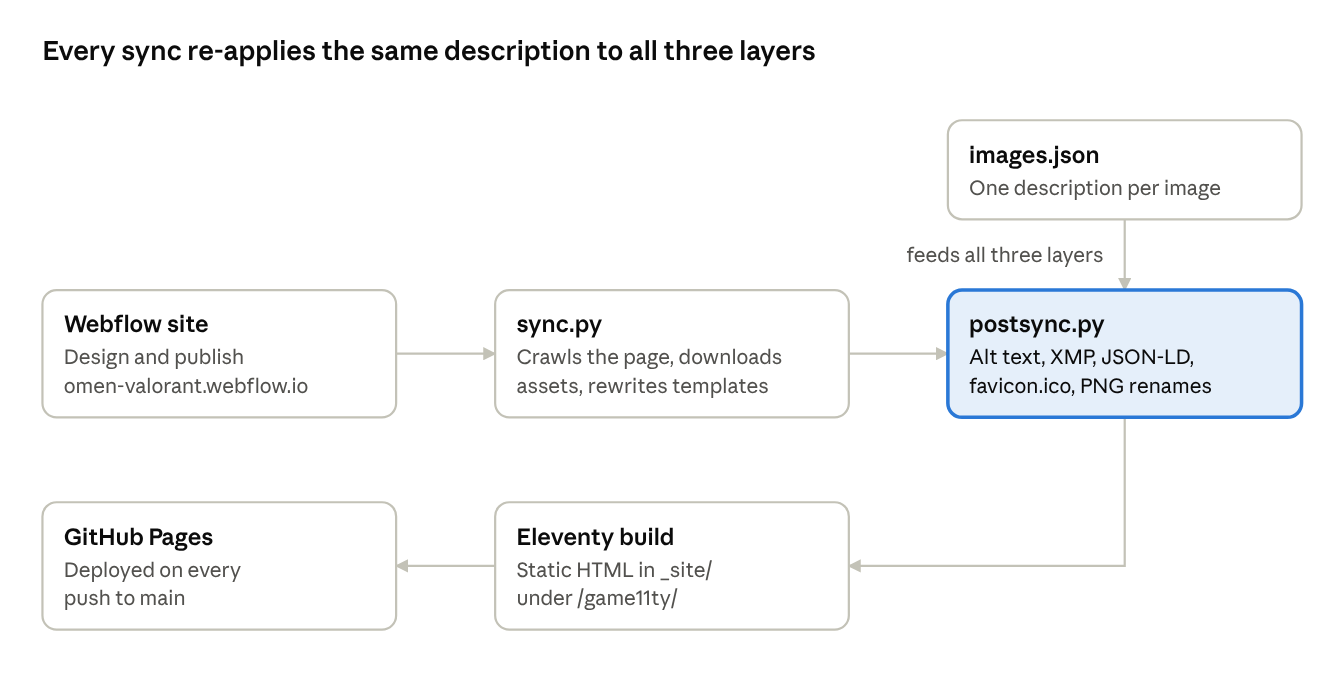
sync.py regenerates the templates from Webflow on every run, so anything added on top would be lost. postsync.py re-applies it from one file, images.json, which holds a single description per image. That one source is what keeps the three layers in agreement.
| Check | Before | After |
|---|---|---|
| Images with XMP | 6 of 12, mostly tool names and IDs | All 9 page images, 5 favicons and the PDF |
| Images with an XMP alt text | 1, describing a laptop when the photo shows a desktop | All 9, matching the page |
| Rights fields (copyright, WebStatement, LicensorURL) | None | Every file, linking to a rights page |
HTML alt accuracy |
2 wrong: the OMEN logo labelled "Valorant Champions", one photo given another's caption | All 9 corrected |
JSON-LD ImageObject |
None | 10 entries with description, licence and copyright |
| Favicon | HyperX logo, JPG declared as image/x-icon |
Original icon, 5 PNG sizes plus favicon.ico |
The rights values are deliberately generic ("© Rights Holder… demonstration rights metadata for agencies"). The site demonstrates the fields; it doesn't claim to own the brand imagery.
14. One image, three channels
The same pixels go out as a social ad, an email hero and a page image. Each channel reads a different layer, so one description has to be placed three ways. Using the game11ty share image as the example:
| Channel | What the machine reads | What survives | Where the description goes |
|---|---|---|---|
| Social ads and link previews | og:image, og:image:alt, twitter:image:alt from the page |
Platforms typically re-encode uploads, so embedded XMP is usually lost | og:image:alt on the page, plus the alt-text field in the ad tool |
The <img alt> in the email HTML |
Many clients block images until the reader allows them, and show the alt text instead; clients don't read XMP | A complete alt that works as copy on its own |
|
| Page | alt, the section's heading, JSON-LD, and the file's XMP |
All three layers | images.json → postsync.py |
A 1×1 tracking pixel in an ad or email is the opposite case: it carries no meaning, so give it alt="". Screen readers then skip it, and parsers don't mistake it for content.
Section IDs paired with H1s as an index
An alt is read in the context of the section around it. The section's id is the machine address (a deep link such as /game11ty/#complete-your-setup), and its heading is the human label. Together they index the page, and the alt text should add to that label, not repeat it.
Section id |
H1 + H2 | Image | Alt text |
|---|---|---|---|
#omenhero |
Omen x Valorant / An Official Partner of the Valorant Champions Tour | Valorant logo | Valorant Champions Paris logo |
#omen-35L-valorant |
No H1 / OMEN 35L Valorant Gaming Desktop Special Edition | Desktop | OMEN 35L Valorant Gaming Desktop Special Edition with two lit front fans |
#follow-the-action |
No H1 / Follow the Action. Fuel Your Game. | Emblem | Red Valorant Champions emblem |
#complete-your-setup |
Complete / Your Valorant Setup | 3 product photos | Bundles for FPS Games: HyperX headset, microphone, keyboard and mouse on a desk (and two more) |
#why-omen-valorant |
Why / Omen x Valorant | Partnership art | OMEN, HyperX and Riot Games partnership artwork for Valorant |
This shows the real gap in game11ty: not how many H1s it has, but what they say. Two of its three H1s ("Complete", "Why") only make sense when read with the H2 below them, and two sections have no H1 at all, so a parser building an outline gets "Complete" and "Why" as top-level topics.
Give every section an id and a heading that reads on its own. A section may open with its own H1 when it stands alone as a topic, and dynamic pages can load several H1s as views or sections arrive. HTML allows this as long as the H1s aren't nested inside one another, though a single H1 per page is still the common recommendation (MDN). Whatever loads, keep the heading order logical (H1, then H2, with no skipped levels) so screen readers and parsers can still build a clean outline:
<section id="complete-your-setup">
  <h2>Complete your Valorant setup</h2>
  <img src="/game11ty/assets/…omentrio2_0014.jpg"
       alt="Bundles for FPS Games: HyperX headset, microphone, keyboard and mouse on a desk">
</section>
The ad or email then links to /game11ty/#complete-your-setup. Someone clicking through lands on the section whose heading, alt text and file metadata all say the same thing.
15. 3D mesh data: CLO wraps and game objects
A 3D garment is a stack of images on a mesh. The fabric "wrap" is a set of UV-mapped textures (base colour, normal, sampler maps) laid over mesh geometry. That makes it two kinds of data, and only the textures have the XMP habits described above. glTF, the standard format for web and game 3D, has its own metadata slots, and they're usually left empty or filled in wrongly.
The CLO jean jacket and avatar on the board, as exported through Adobe Substance 3D Stager:
| File | Size | Mesh data | Textures | What its metadata says |
|---|---|---|---|---|
jeanjacket.glb |
8.2 MB | 152 meshes, 98,560 vertices, 6.1 MB | 19 embedded, 1.7 MB; 7 carry XMP | asset.copyright: "2025 (c) Adobe Inc." |
maramodel.glb (avatar) |
2.1 MB | 12 meshes, 24,303 vertices | 7 embedded | asset.copyright: "2025 (c) Adobe Inc."; skeleton joints as plain nodes, no skin |
jeanjacket.gltf + .bin + 21 loose images |
6.7 MB | same jacket, split into separate files | 8 of 21 carry XMP | same Adobe copyright |
Three things stand out:
- The exporter claimed the copyright. Stager wrote Adobe's own copyright line into
asset.copyrighton all three models. A crawler or marketplace reading that field would credit Adobe, not the designer. Overwrite it on export. - Names carry the lineage, not the metadata. Node and material names record where each part came from:
JEANALL2%2Eroblox_n3d(a Roblox-sourced scene),Denim_Lightweight_FRONT_4584(a CLO fabric), andMara:andFeifei_hair(CLO avatar parts). That's useful tracking data, but it's informal and gets lost on rename. - No game-object IDs. None of the 189 nodes has
extrasor an extension. A game engine or tracking system has nothing stable to hang analytics, SKUs or ownership on.
Where 3D metadata goes in glTF
| Slot | Scope | Use it for |
|---|---|---|
asset.copyright, asset.generator |
Whole file | Rights holder and the tool that made it |
KHR_xmp_json_ld |
Whole file, or one scene, node, mesh, material or image | Full XMP (dc:, xmpRights:, IPTC) as JSON-LD; object-level packets override the file-level one |
extras |
Any object | Your own tracking fields: game-object ID, SKU, garment piece |
| Texture XMP | Each embedded JPG or PNG | Alt text and rights for the wrap itself |
KHR_xmp_json_ld is a ratified Khronos extension (spec). It lets the same rights fields used on game11ty's images travel inside the 3D file, down to a single garment piece. Here is the jacket with a file-level packet and one tracked game object:
{
  "asset": { "version": "2.0", "copyright": "© Rights Holder", "generator": "CLO → Substance 3D Stager" },
  "extensionsUsed": ["KHR_xmp_json_ld"],
  "extensions": { "KHR_xmp_json_ld": { "packets": [{
    "@context": { "dc": "http://purl.org/dc/elements/1.1/",
                  "xmpRights": "http://ns.adobe.com/xap/1.0/rights/" },
    "@id": "",
    "dc:title": "Lightweight denim jacket",
    "dc:description": "Light-wash denim jacket on a CLO avatar, 152 garment pieces",
    "xmpRights:WebStatement": "https://example.com/rights/"
  }]}},
  "nodes": [{
    "name": "Cloth_mesh_n3d",
    "mesh": 0,
    "extras": { "gameObjectId": "jacket-front-left", "sku": "DJ-4584", "fabric": "Denim_Lightweight_FRONT_4584" },
    "extensions": { "KHR_xmp_json_ld": { "packet": 0 } }
  }]
}
The IDs and SKU are placeholders. Reading it back takes a few lines of Python, because a .glb keeps its JSON in the first chunk after a 20-byte header:
import json, struct

data = open("jeanjacket.glb", "rb").read()
length = struct.unpack("<I", data[12:16])[0]       # JSON chunk length
gltf = json.loads(data[20:20 + length])

print(gltf["asset"].get("copyright"))              # who the file says owns it
for node in gltf["nodes"]:
    if "extras" in node:                             # tracked game objects
        print(node["name"], node["extras"].get("gameObjectId"))
Run against the real jacket today, the first line prints "2025 (c) Adobe Inc." and the loop prints nothing. That's the gap a 3D pipeline needs to close: the rights field is wrong and the game objects are untracked.
Tool references: from Illustrator art to a 3D model
Artwork often starts as a vector in Illustrator, gets wrapped onto a model in Substance or Cinema 4D, and ends up in an After Effects render or a web viewer. Each hand-off is a chance to keep or lose the description and rights.
| Tool | What it makes | Metadata it keeps or writes | Where it's lost |
|---|---|---|---|
| Illustrator (3D and Materials panel) | Extruded and revolved 3D objects with Substance materials; exports glTF, USDA, USDZ and OBJ since version 27.0 (Adobe) | The .ai file's own XMP |
OBJ export keeps only the object's colour, not its Substance materials |
| Substance 3D (Painter, Stager) | Texture sets (base colour, normal, roughness) and staged scenes exported as glTF/GLB (Stager formats) | XMP in some exported textures; asset.generator |
Stager wrote "2025 (c) Adobe Inc." into asset.copyright on the jacket and avatar |
| Cinema 4D | Modelling, UV unwrapping, animation; glTF 2.0 export with an optional Draco setting in recent versions (guide) | Object and material names | Anything not mapped to a glTF field |
| Cinema 4D Lite (ships with After Effects) | A limited Cinema 4D for building 3D scenes that render inside After Effects through the Cineware plug-in (Adobe, Maxon) | Lives as a .c4d layer in the AE project |
The 3D data stays in the AE project; renders carry only AE's XMP |
| After Effects | Video and image-sequence renders | With Include Source XMP Metadata on, writes markers, comments, project XMP and every source file's XMP into the render; off, only a unique ID (Adobe) | Off by default in many output modules: check it |
The weak points are the exporters, not the tools. Set the copyright and description at the last export, check asset.copyright in every GLB, and turn on Include Source XMP Metadata in After Effects when a render has to carry rights.
Video poster images
A video's poster frame is an ordinary JPG or PNG, so it carries XMP rights like any other image. It's also the part of a video that machines see first. A <video> element has no alt, crawlers index the thumbnail rather than decoding the video, and social previews show the poster. That makes the poster the video's rights label on the web.
<video controls poster="/media/omen-teaser-poster.jpg"
       aria-label="OMEN x Valorant teaser: the OMEN 35L desktop on stage in Paris">
  <source src="/media/omen-teaser.mp4" type="video/mp4">
</video>
<script type="application/ld+json">
{ "@context": "https://schema.org", "@type": "VideoObject",
  "name": "OMEN x Valorant teaser",
  "description": "The OMEN 35L desktop on stage in Paris",
  "thumbnailUrl": "https://example.com/media/omen-teaser-poster.jpg",
  "uploadDate": "2026-10-03",
  "license": "https://example.com/rights/" }
</script>
The file names and dates are placeholders. Write the same description and rights into three places: the poster's XMP, the VideoObject JSON-LD (thumbnailUrl points at the poster), and the video file itself. For that last one, turn on Include Source XMP Metadata when rendering from After Effects. If the video is re-encoded or stripped, the poster still carries the rights.
Video optimization in Adobe Media Encoder
Media Encoder is where a video's size and its metadata are decided together. The Metadata button in Export Settings offers two ways to keep XMP: Embed in Output File or Create Sidecar File, a separate .xmp next to the video (Adobe). Users on Adobe's forum report that embedding is greyed out for H.264 MP4 and available for QuickTime (Adobe community). So the most common web format often ships with no rights inside it.
| Setting | Web recommendation | Why |
|---|---|---|
| Format | H.264 (MP4) for reach; H.265 or AV1 where supported | Smaller files at the same quality |
| Bitrate encoding | VBR, 2 pass | About 10% better quality for the same size, at roughly twice the encode time (guide) |
| Maximum bitrate | About 2× the target | Leaves room for fast motion without raising the average |
| Target bitrate | About 16 Mbps for streaming uploads; lower for embedded web video | Platforms re-encode anyway; 32–40 Mbps is master quality (guide) |
| Metadata | Create Sidecar File for MP4; Embed for QuickTime masters | Keeps the rights whether or not the container can hold XMP |
| Poster | Export a still frame as JPG and give it rights XMP | The frame crawlers and social previews index |
For game footage like the Valorant streams on the board, fast motion is what eats bitrate. Keep 2-pass VBR, and put the rights in the sidecar, the poster and the VideoObject JSON-LD. Don't rely on the MP4 alone.
Draco compression
Draco is Google's open-source codec for compressing mesh geometry: vertex positions, normals, UVs and triangles. It isn't a media type of its own. In glTF it's carried by the KHR_draco_mesh_compression extension (Khronos), and the file is still served as model/gltf-binary (.glb) or model/gltf+json (.gltf).
I ran the jean jacket through Draco with gltf-transform to see what it costs and what it keeps:
| Original | Draco | |
|---|---|---|
| File size | 8.19 MB | 2.86 MB (65% smaller) |
asset.copyright |
2025 (c) Adobe Inc. | Kept |
asset.generator |
Adobe Substance 3D Stager | Replaced by glTF-Transform v4.5.1 |
| Node names (189) | JEANALL2%2Eroblox_n3d … |
Kept |
| Textures with XMP | 7 of 19 | 7 of 19 (textures aren't touched) |
| Viewer needs | Any glTF viewer | A Draco decoder (extensionsRequired) |
Draco only compresses geometry, so the mesh data shrinks and the textures and their XMP pass through untouched. It does rewrite asset.generator, and the one tool-specific extension in the jacket (EXT_materials_specular_edge_color) triggered a warning. Run your rights and tracking fields through the compressor and check them afterwards, as you would for a WebP conversion.
Two layers, two owners. A 3D file splits the same way an image does. The geometry underlayer is open and Google-optimised: Draco compresses it and any glTF viewer with a decoder can read it. The shading layer is Adobe-bound. Substance materials are procedural inside Adobe's tools, and leave them only as baked textures plus standard PBR settings. In the jacket, the Khronos KHR_materials_specular setting survived Draco on 12 of 13 materials. Stager's own EXT_materials_specular_edge_color declaration was dropped, though no material used it. Rights for the geometry belong in glTF fields. Rights for the look belong in the texture XMP and the material's KHR_xmp_json_ld packet, because that's the part that stays tied to Adobe's material model.
16. Checklist for agencies and media teams
- Keep one description per image in a single source file, and generate the
alt, XMP and JSON-LD from it - Write alt text that adds to the section's heading instead of repeating it
- Give every section an
idand a heading that reads on its own; separately loaded sections may each bring an H1 (never nested), with no skipped heading levels - Embed Copyright Notice, Creator, Credit Line, Web Statement of Rights, Licensor URL and a Data Mining value
- Point the Web Statement of Rights and the JSON-LD
licenseat the same live rights page - Set
og:image:altfor every share image, and fill the alt-text field in ad tools - Write email alt text that works as copy when images are blocked; give tracking pixels
alt="" - Turn on metadata keeping in every encoder and optimiser (e.g.
cwebp -metadata xmp) - Strip edit history and padding from web copies; keep the full packet in the DAM
- Serve favicons as PNG and ICO from a 512 px source, with no third-party logos
- Re-check the live site with a parser after every build or sync
exiftool commands
# Read the description and rights fields
exiftool -AltTextAccessibility -Description -Rights -WebStatement -LicensorURL -DataMining photo.jpg

# Write a minimal rights set (JPG, PNG and WebP)
exiftool -overwrite_original \
  "-XMP-iptcCore:AltTextAccessibility=Player at an OMEN desktop with red-lit fans" \
  "-MWG:Description=Player at an OMEN desktop with red-lit fans" \
  "-MWG:Copyright=© Rights Holder" "-MWG:Creator=Rights Holder" \
  "-XMP-xmpRights:WebStatement=https://example.com/rights/" \
  "-XMP-plus:LicensorURL=https://example.com/rights/" photo.jpg

# Web copy: drop edit history, keep everything else
exiftool -overwrite_original -XMP-xmpMM:all= photo.jpg
Sources
- IPTC Photo Metadata Standard 2025.1
- Google Search Central: image license metadata
- Google Search Central: favicons in search results
- WebP container specification
- Khronos KHR_xmp_json_ld
- Khronos KHR_draco_mesh_compression and Google Draco
- Adobe: XMP metadata in After Effects
- Adobe: Cinema 4D and Cineware in After Effects and Maxon: Cineware
- Adobe: export 3D vector artwork in Illustrator
- Adobe: Substance 3D Stager import and export formats
- Adobe: Media Encoder export settings reference, Adobe community: XMP embed disabled for MP4 and Annenberg Digital Lounge: compress video for the web with Media Encoder
- CRM Sync knowledge base: Asset Management, Security and AI (companion article)
- Wikipedia: OpenAI–HuggingFace incident
- Cloudflare: allow traffic from IPs in an allowlist, Xano: encrypting fields and Xano: Addons
- Wikipedia: List of file signatures, Gary Kessler: File Signatures Table, MDN: MIME types and WHATWG MIME Sniffing
- Shopify: stagedUploadsCreate, Shopify: fileCreate and Webflow: Upload Asset, WordPress REST API: Media
- Shopify: app proxies, WordPress: HTTP API, Astro: environment variables and Next.js: environment variables
- RFC 9309: Robots Exclusion Protocol, RFC 9116: security.txt, llmstxt.org and Google: qualify outbound links
- Helmet, Cloudflare Workers: set security headers and Cloudflare community: Shopify and the Cloudflare proxy
- Hacktron: Hacking OpenAI
- Cloudflare: mutual TLS, European Commission: CRA reporting, GOV.UK: consumer connectable product security, Shopify: Functions languages and Shopify Help: product media types
- PCI SSC: SAQ A eligibility, Xano for Enterprise, Cloudflare HIPAA FAQs, HIPAA Journal: Shopify, Goodwin: My Health My Data Act and FTC: Health Breach Notification Rule
- Becker's: Sharp HealthCare lawsuit, HIPAA Journal: Sutter and Memorial lawsuit, The HIPAA E-Tool: HCIactive, Medical Economics: Netskope healthcare report and HIPAA Journal: March 2026 breach report
- Stripe: idempotent requests
- How to export Cinema 4D to GLB
- Measurements and parser output: game11ty files, the live site and the CLO jacket and avatar GLBs, 3 October 2026